
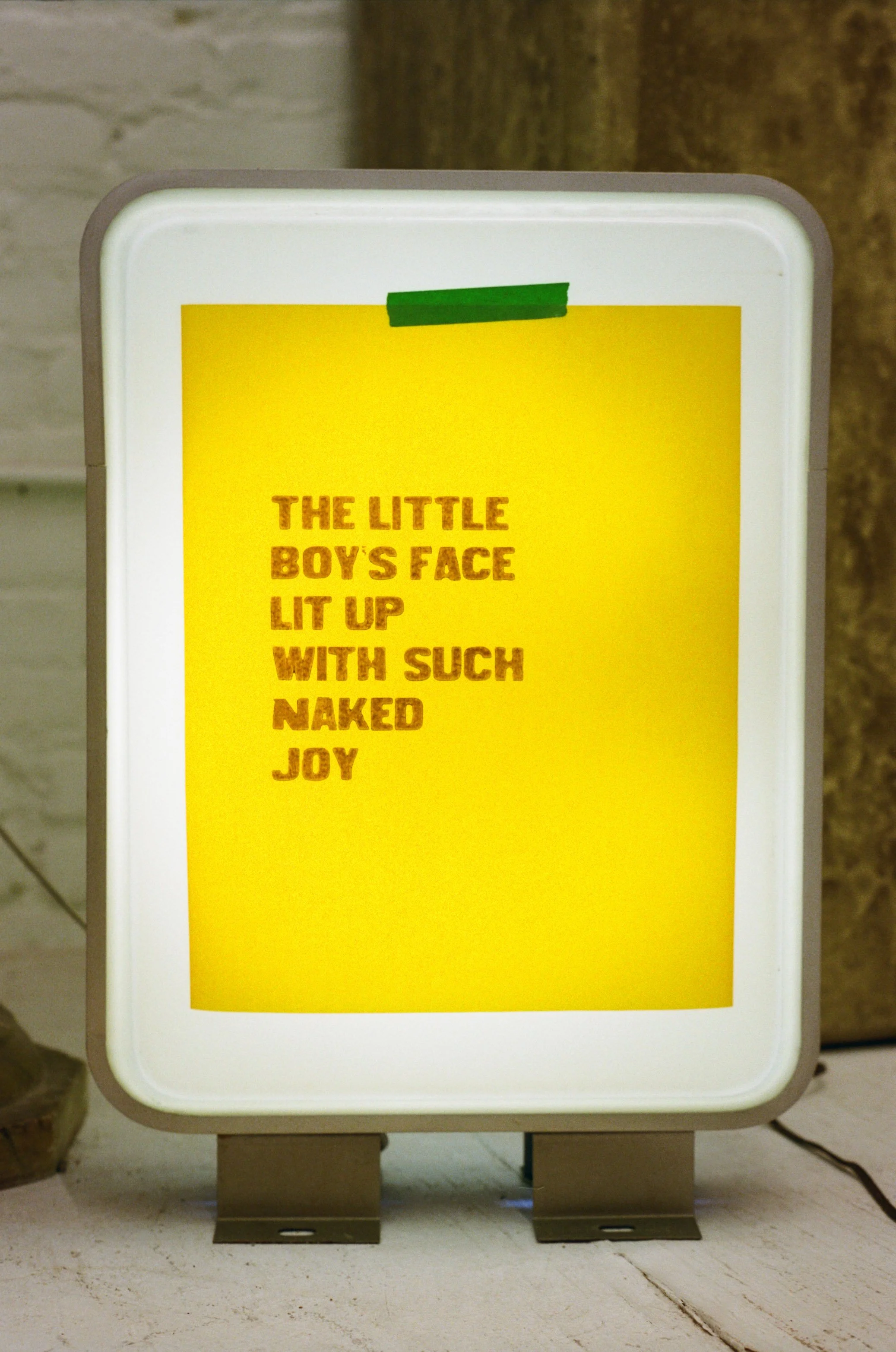
Michael Stipe | Naked Joy
Michael Stipe is best known as the frontman of R.E.M., the band that reshaped the emotional vocabulary of American rock. But beyond the voice that made ambiguity unforgettable, we’ve long been drawn to something else—his taste: what he notices, what he collects, and how he, as an artist and photographer, gives meaning to it all.
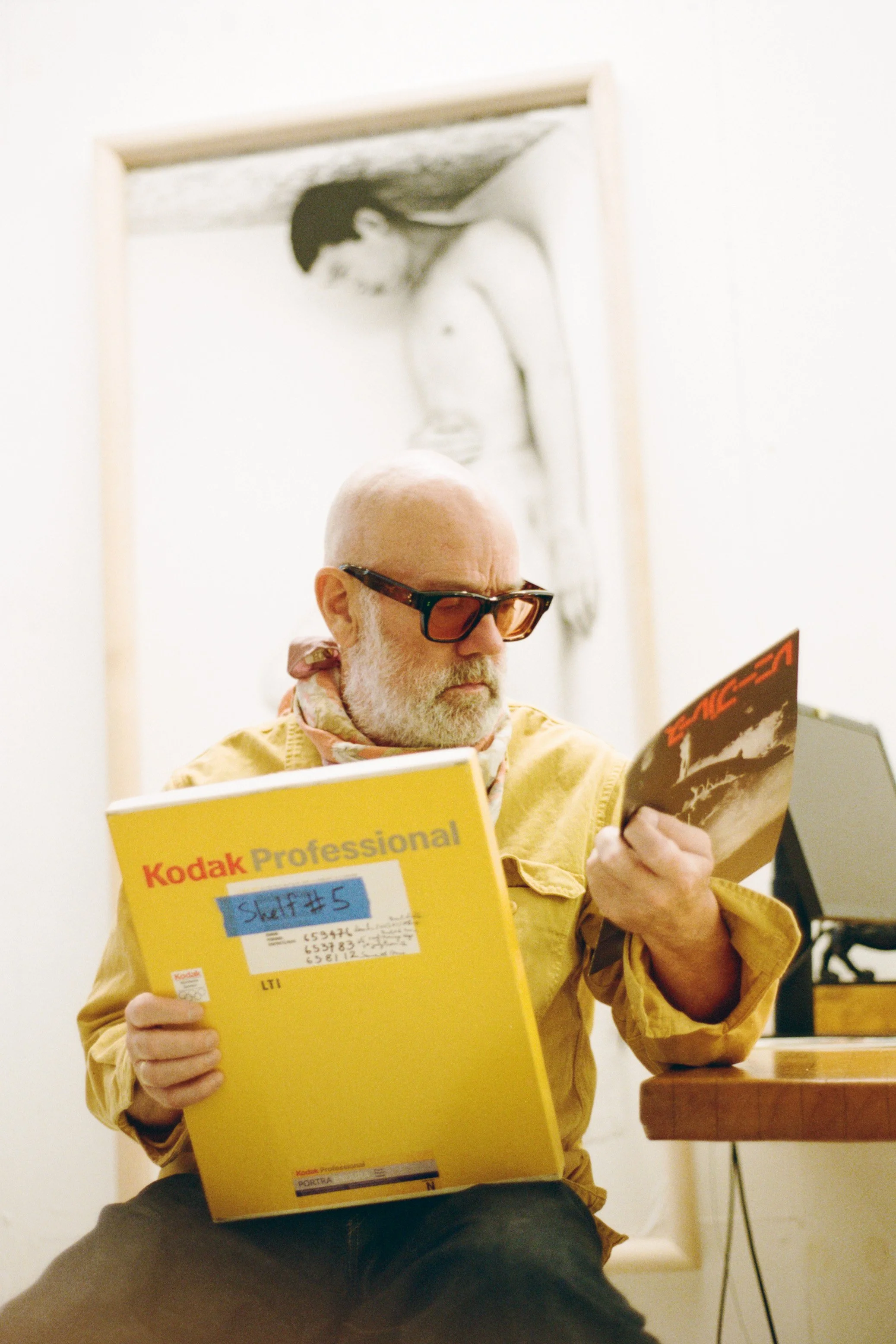
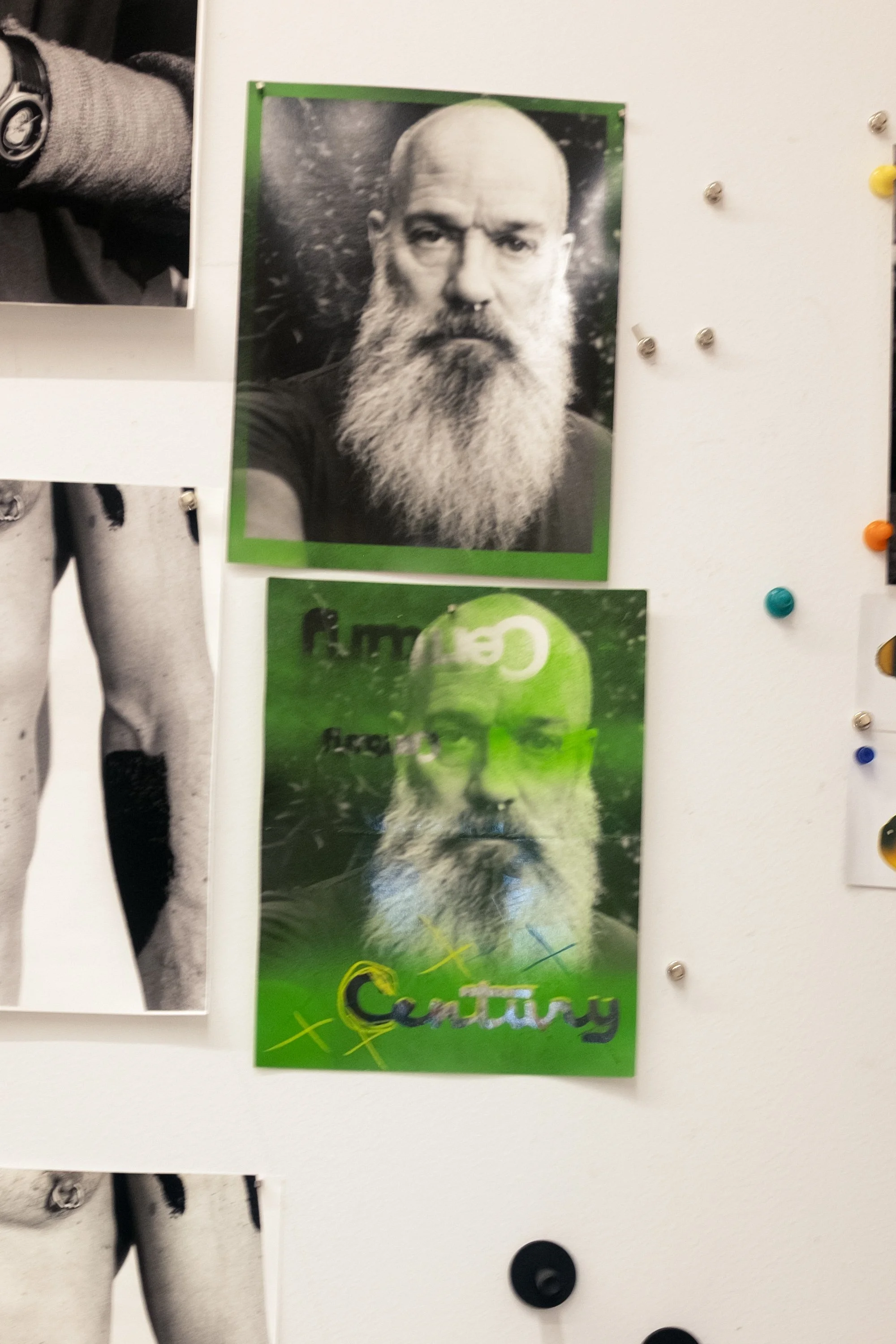
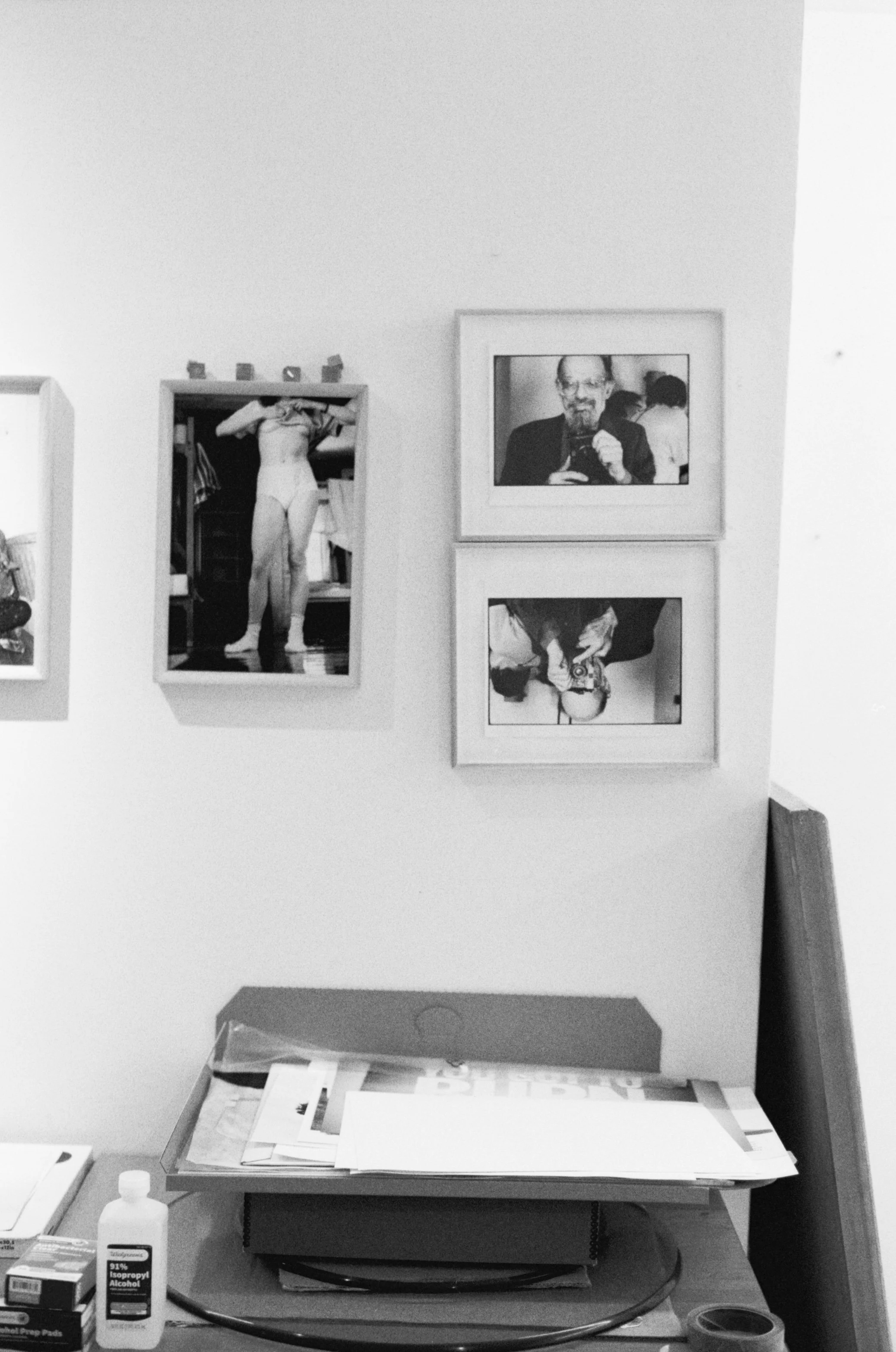
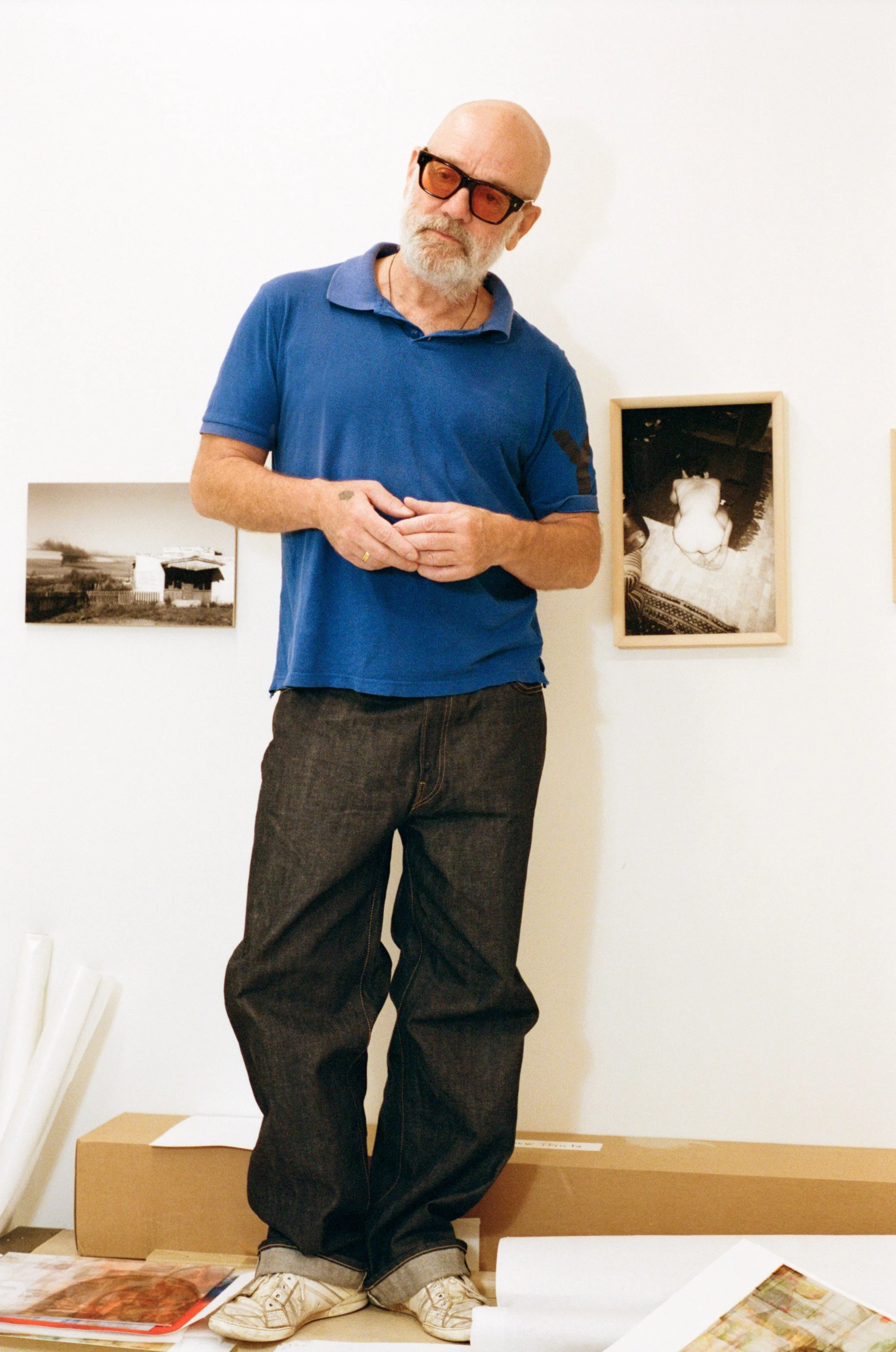
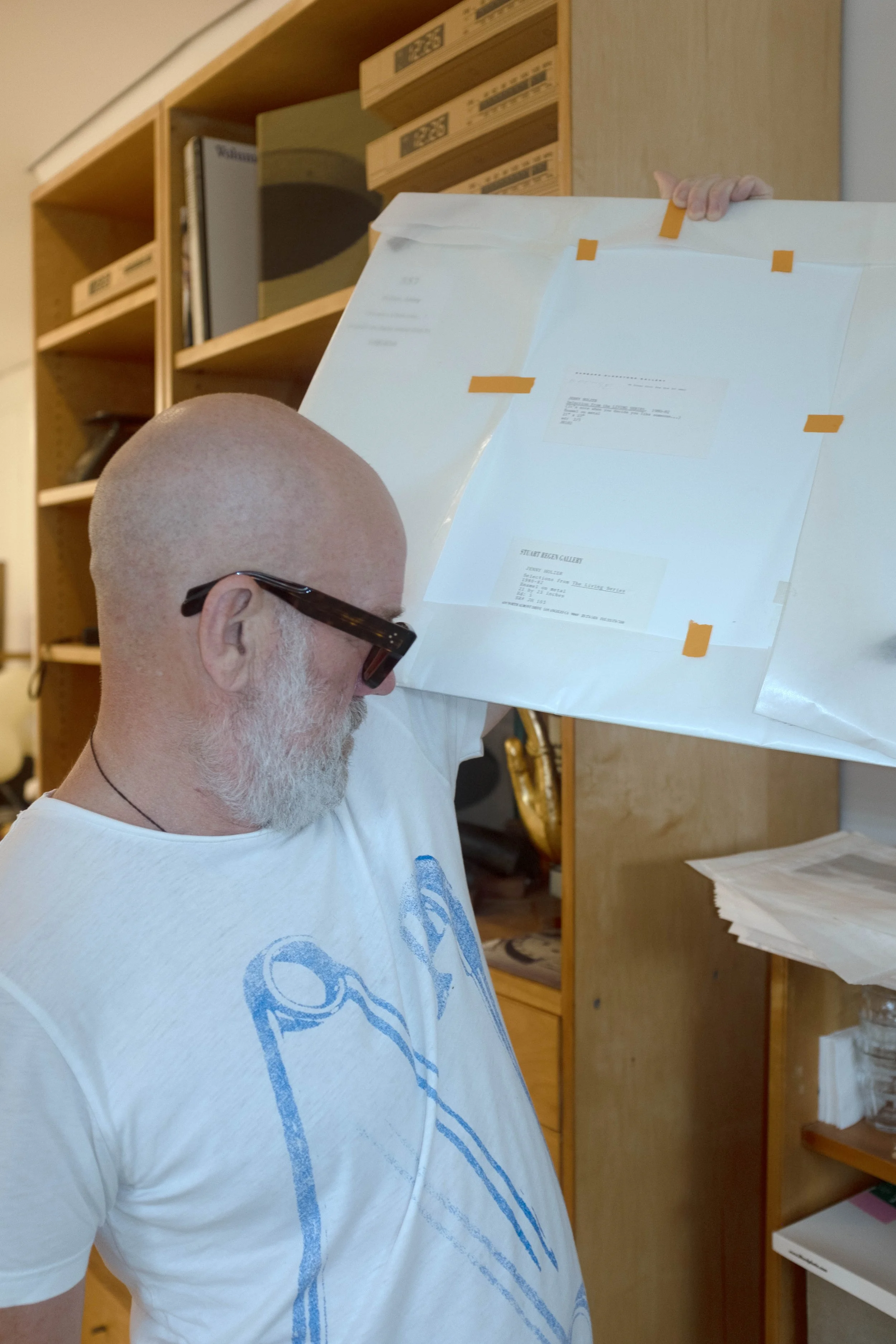
Instead of looking back, we asked to visit. His East Village studio is a lived-in index of emotion and impulse. A stiletto heel balances on a turntable. A sculptural golden hand stands upright between books and archival boxes. The walls are gently marked, some images pinned, others leaning. It’s a space that invites free exploration of all kinds.
We walked with him through the neighborhood. He moved freely, like a real person who lives here, rather than a rock star. Resting on railings, swinging around lampposts, climbing stone ledges. It’s no news that New Yorkers don’t pay attention to anyone, yet the chill and ease of Michael feels unforced. There’s no pretending around him.
Parallel to how he looks, there is also a list that reflects how he lives—the things that speak for him. He gave us a sprawl of names, fragments, memories, associations: Doris Salcedo’s installations, Amanda Lepore, dolphin sightings in Malibu, the scent of 1970s Dunkin’ Donuts, Roy Cohn’s archive, dragonflies, blue marble bathrooms, the wardrobe of Noguchi, Joan Jonas’ dog, Warhol’s camera. Some poetic. Some political. Some just felt.
To open up that world further, his longtime friend and fellow artist Taryn Simon joins the conversation.
Taryn and Michael have known each other for years, shaped by a deep and evolving exchange. Their friendship holds space for contradiction—for logic and emotion, structure and intuition, visibility and silence. When they appeared together at the New York Public Library last year, they spoke not just as artists, but as people who have long explored how the private self sits inside public systems. The conversation drifted from photography to grief, from the idea of memory as fiction to the weight of mourning before one is ready to speak.
Their practices are different, yet aligned. Taryn’s work investigates control—legal, emotional, institutional. She reveals how narratives are constructed, archived, and protected. Michael’s is more instinctive, but equally concerned with what gets held, what disappears, what resists explanation. Both are committed to the politics of visibility, and each has spent their careers moving between what’s said and what stays in the margins.
By throwing out questions back and forth—two close friends who “didn’t like each other at first”—the conversation deepens what leads us to Michael, and to their bond: the value of withholding, the vulnerability of showing, and the power of building an archive. Life may set some boundaries, but honestly facing them is what invites the space in.
You had a conversation at New York Public Library last year, and you both spoke about memory and privacy.
Michael Stipe (MS): From time to time, I question whether or not I experienced something or only thought that I did. In terms of grieving, I think keeping memories and grief within a private sphere is smart, and by that I mean, of course friends and family, but not publicly announcing one’s grief and the details of that process.
Taryn Simon (TS): Sometimes the things we keep quiet, the things we never speak of, are the most preserved. They don’t version or change.
Does a memory need a witness? And if so, who or what is that witness?
TS: No. Engaging with memory that way is for legal processes. The requirement for a witness is linked to the idea of ratifying a memory. But a memory doesn’t need to be shared to exist.
Almost all conversation trades in memory. In Paperwork and the Will of Capital, flowers were the witness. The only other living organism in the room while powerful men tried to sculpt reality.
MS: A journal? A close friend?
I have a dear friend who has lived a very rich and storied life and tells me things that I am pretty sure no one else knows or has heard. I have such a bad memory that I feel like these stories—although enjoyed in the moment, often with shocking revelations or details—are lost on me because of my wretched memory.
The act of hoarding can feel like a personal belief system. Does it seem more like a truth-seeking process or a consequence-carrying one to you?
MS: The truth part feels like an attempt to understand the past by sentimentalizing it, or applying too much importance to unimportant things. The consequence is a diminished present and future—unless you’re preparing for your (imagined, self-importantalizing archivists)
TS: My challenge with it has always been that it starts from an optimistic space of having infinite room for everything. There’s a lot of impulsivity in it. And as things just sit, the objects and ideas become a challenge to the future—for dissection and preservation, standing in defiance of floods and dying.
What is the emotional cost of holding on?
TS: I think it’s totally maternal, and that comes with some pain and desperation—being confronted with non-spiritual impermanence.
MS: It feels paralyzing to me at a certain point in life, and I have most definitely reached that point. Nothing can move forward much until the past has been sorted and largely discarded.
What people choose to keep often says more about them than they realize. But what they choose to remove says even more. What is something you’ve recently kept or removed?
TS: I collected all of my father’s prescription pill boxes for decades. There were thousands in auburn plastic. As he got sicker—I didn’t want them.
My problem now is I want to keep things, but I’ve run out of space and can’t remember where I’ve put them—in my brain, my work, and my apartment.
MS: I just got shed of 3 mink coats, one floor length, that I bought when a dry cleaner closed and sold for dirt cheap all their unclaimed garments. I was thrilled to see them go.
I recently kept a weirdly important-to-me cardboard box for shipping limes. I’ve become obsessed with lime packaging.
Michael has said that vulnerability is his superpower. As an artist, how do you know when a work holds the right kind of vulnerability—not too guarded, not too exposed?
MS: I never knew about the work initially, but hopefully by the time it’s released to the public, you will have figured that out. I feel very strongly about works that then later feel silly or too easy, or just misjudged. I am constantly over-emotional about basically everything—it’s the filter through which I process the world and my own thoughts. It’s exhausting.
TS: For me—there’s no right kind of vulnerability. I think it’s more elemental: it’s there or it’s not. As I get older, everything gets more intricate and feels important and doomed.
What does it mean to stay vulnerable when truth itself feels unstable? When the world rewards control, certainty, and detachment, how do you stay open without falling apart?
MS: Per the above response, you work to disallow vulnerability in every aspect of life—that would be insane and super difficult.
Truth does not feel unstable to me. There are life mysteries that remain and are unanswerable, and I am just fine with that.
TS: I don’t know any other way. It’s not a choice. We are products of a lot of different eras, parents, ideologies, weather, fashions, deaths, hormonal imbalances, surprises. Whatever the small world we inhabit is today, we can’t erase the versions of a brain and body built through time—through an ancestry and time that precedes a physical life. My daughter’s eggs were in her in me. And so on.
Whoever controls the frame controls the narrative. How do you navigate authorship when what you are capturing resists control, whether it is emotion, grief, randomness, or contradiction?
MS: This is a language I don’t understand!
TS: The frame no longer controls the narrative at all. There’s room for any idea now because the response to ridiculousness is total freedom.
You have both worked with fragments, absences, and omissions—moments where what is missing says as much as what is shown. How do you decide when to name something and when to let it remain undefined?
MS: I love undefined. I seek it in feature films, novels, pop songs. Chaos and God are in the mistakes, and it’s just a matter of allowing those to not be mistaken as uninteresting or unneeded.
TS: I think setting out to make something undefined has always felt empty to me. I usually work toward getting to some sort of center, which then breaks into something surreal just through acts of nature.
In The Odyssey, the sea is “wine-dark”—not blue. Scholars once thought the Greeks couldn’t see blue, but it was the word that didn’t exist yet. Language can lag behind perception. So can image. Have you felt form fail feeling, or reveal something new?
MS: All the time. This is why music and voice are such great conduits for the often inexpressible in other mediums.
TS: I sometimes think I’m just not looking hard enough—that there are more than ghosts if I can just find the crack. I try to make things in which the mirage is something we can hold in our hands.
Words and interview by Murphy Guo. Photography by Benedict Brink.