
Mamma Andersson | Let Painting Lead
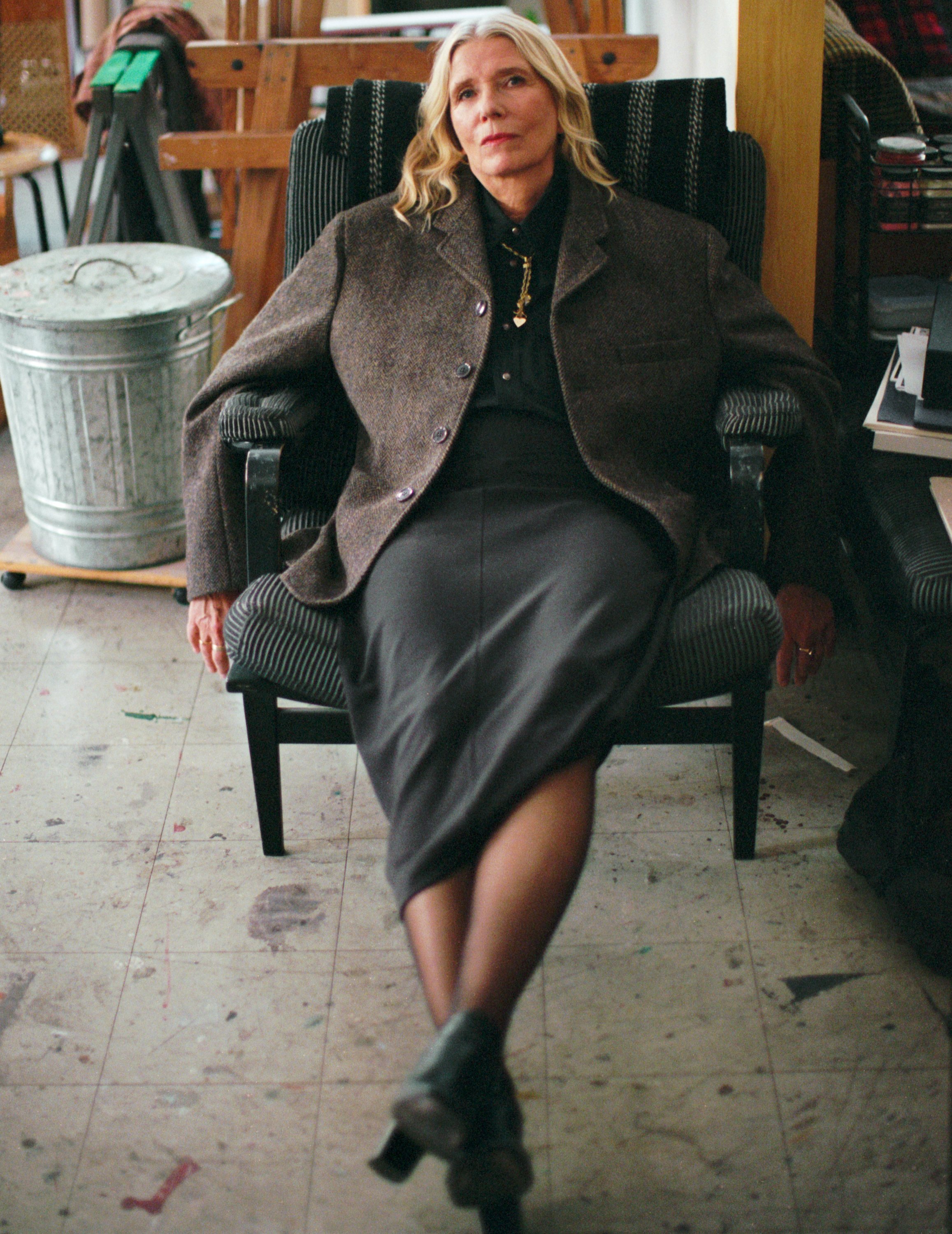
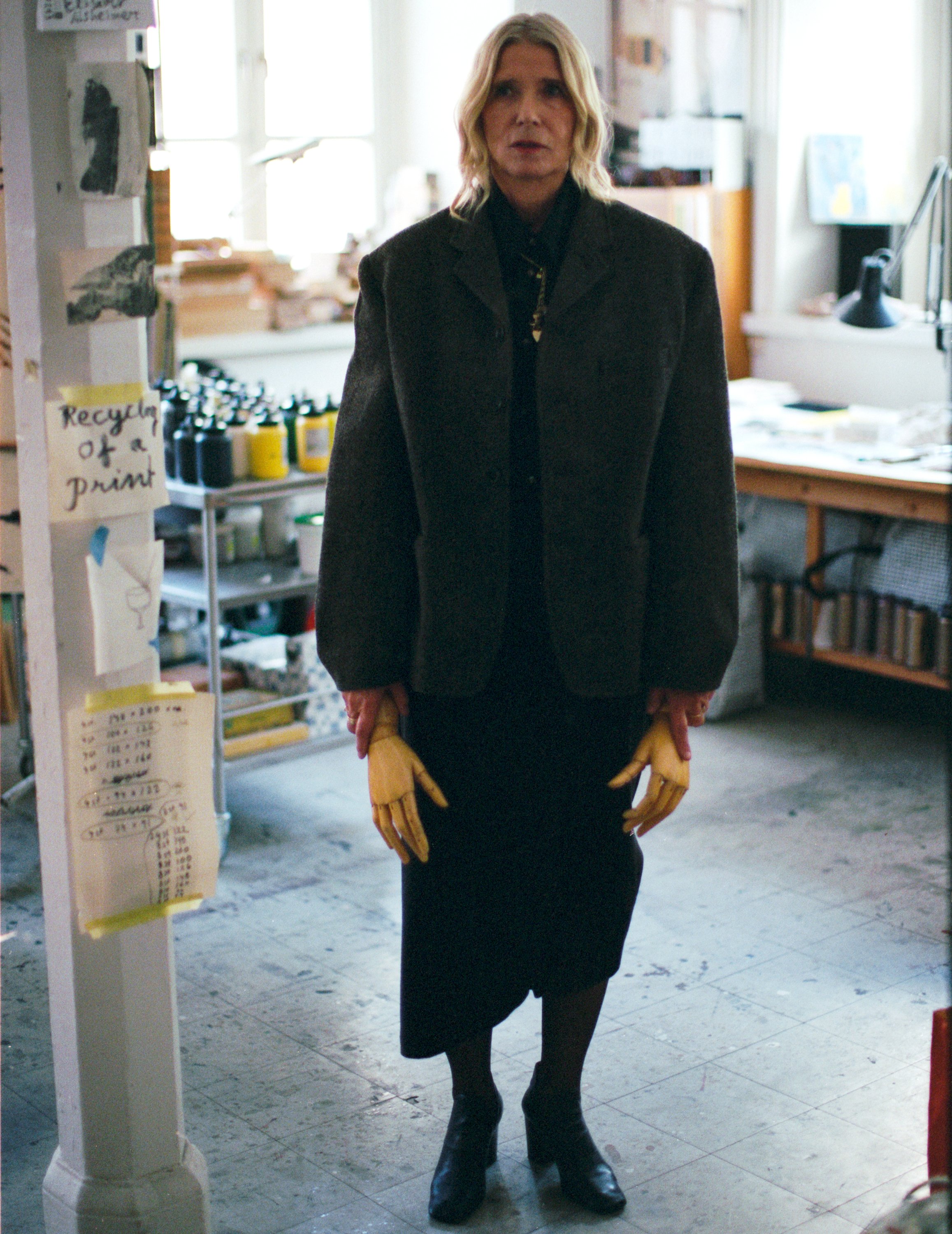
Mamma Andersson wears a blazer, a shirt, a skirt, and shoes by LEMAIRE, tights by FALKE, necklace artist’s own.
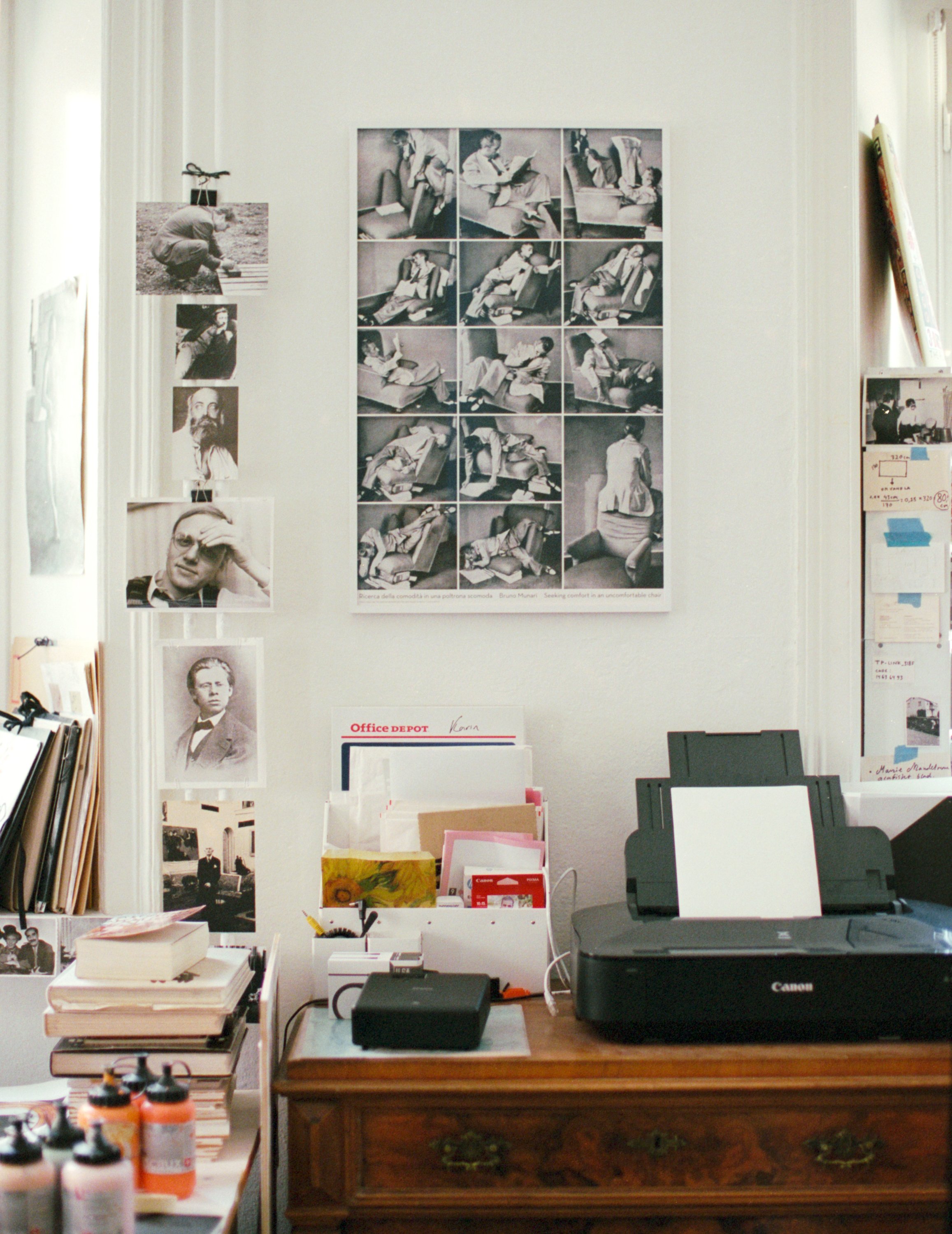
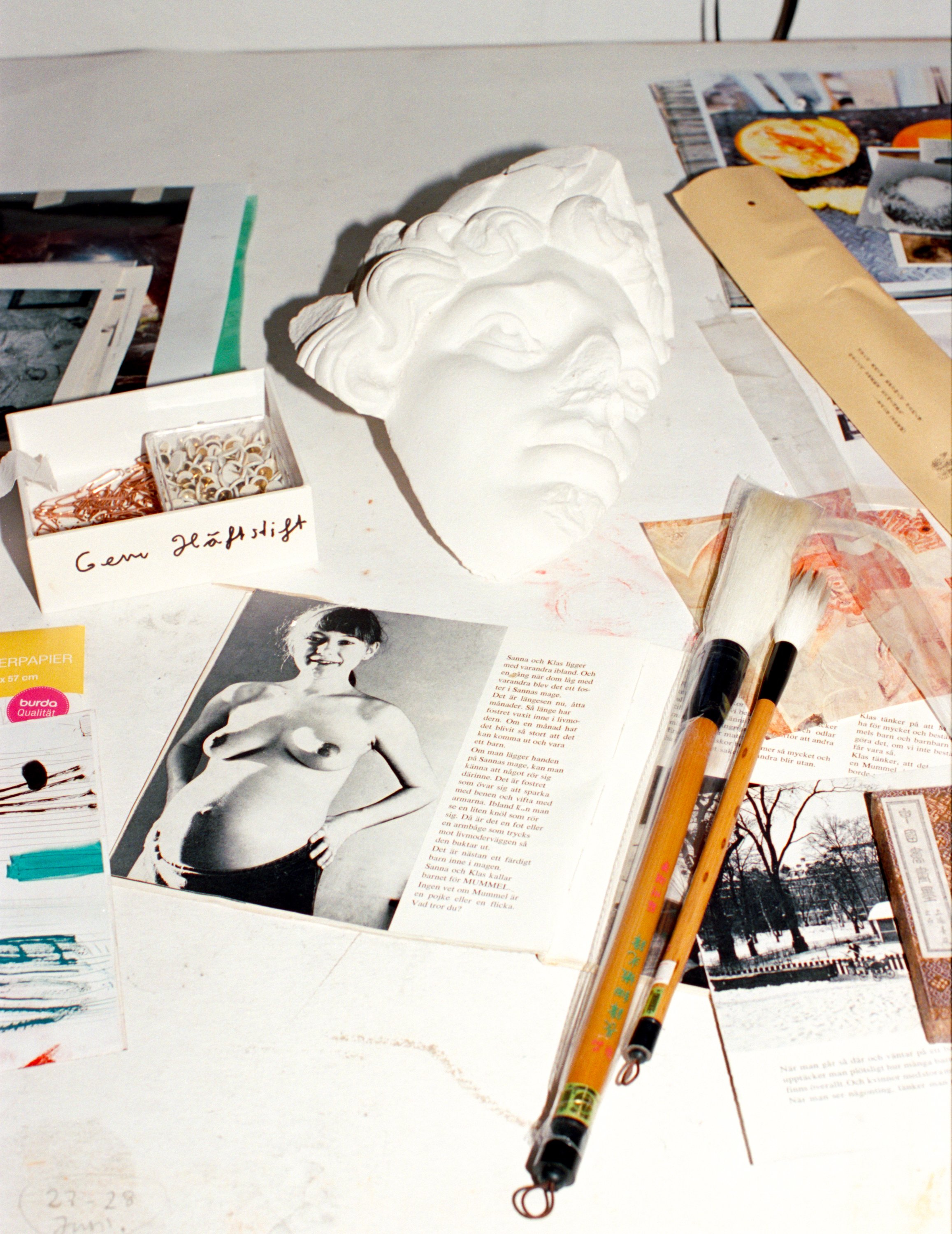
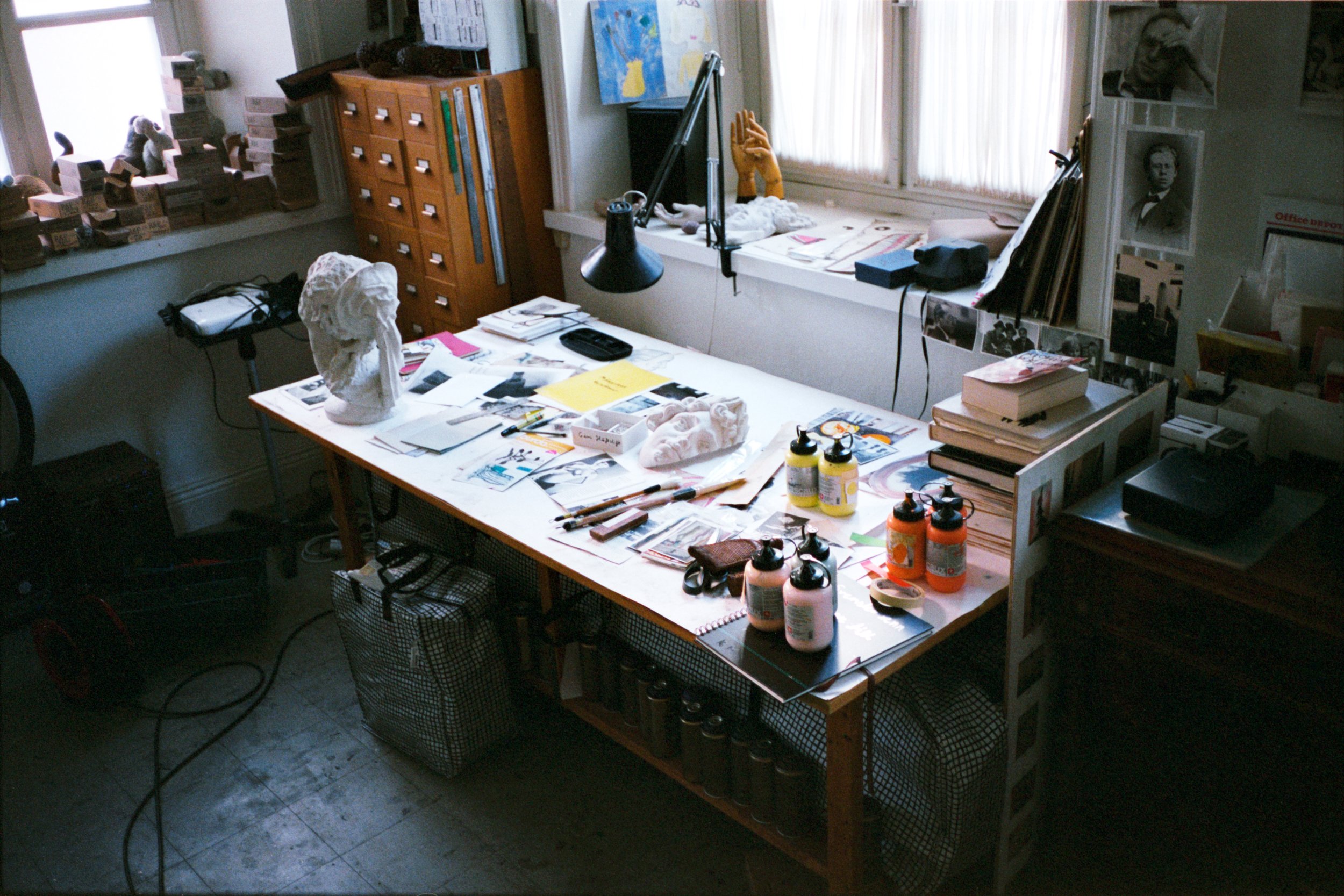
Stillness can hold tension too. In Mamma Andersson’s studio in Stockholm—where sunlight pools on the scratched floor, where glass bottles of hand-mixed pigments line the windowsill like quiet sentinels—painting doesn’t announce itself. It waits. The room hums with the residue of work: collapsed tubes of paint, books stacked like cairns, a labeled bottle marked “Mahogany.” Nothing is overly tidy, but everything is exactly where it belongs. She, too, is like this: unhurried, deliberate, letting silence do some of the talking.
Raised near the Arctic Circle in Luleå, Andersson grew up among forests and long winters, surrounded by nature, film, and a kind of emotional economy. Her paintings carry that imprint. Interiors, forests, partial figures, and staged stillnesses surface with the logic of dreams. Faces are turned away or replaced by dolls; black may mean death, or tenderness. “There are no rules in my work; I follow my impulses. Sometimes it becomes a human gaze, other times something else entirely,” she says.
What sets her apart isn’t just subject or palette, but restraint. In an art world that often demands clarity, message, or spectacle, Andersson offers something else: ambiguity as invitation. She doesn’t paint to declare truth or react to headlines. She doesn’t chase relevance. She reads, walks, visits museums, protects her time, silences the news. She lets painting lead.
Each work might be a kind of self-portrait, but not the kind that stares back. Rather, like her studio—worn, glowing, deeply alive—it becomes a vessel for remembering, sensing, and staying just out of reach.
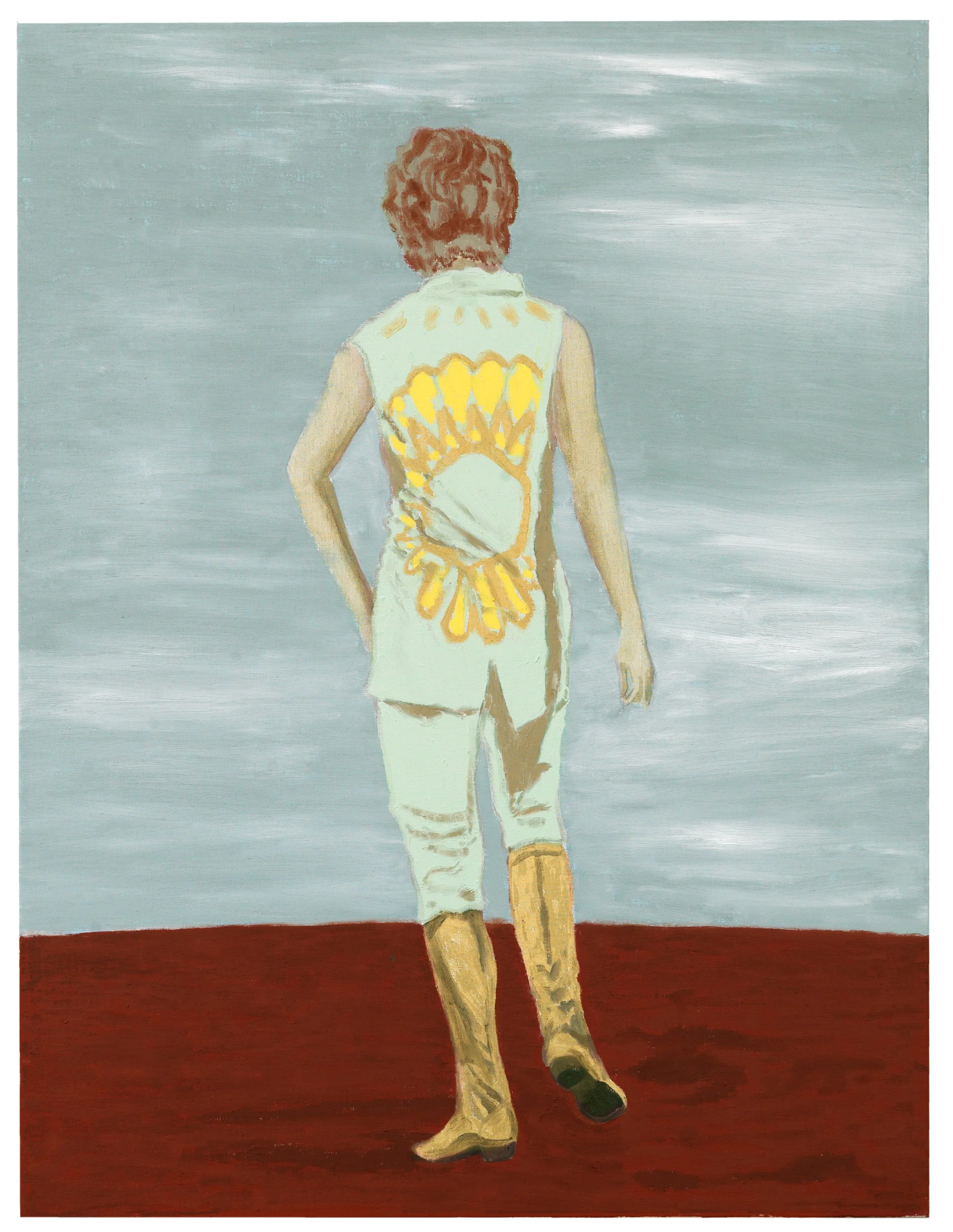
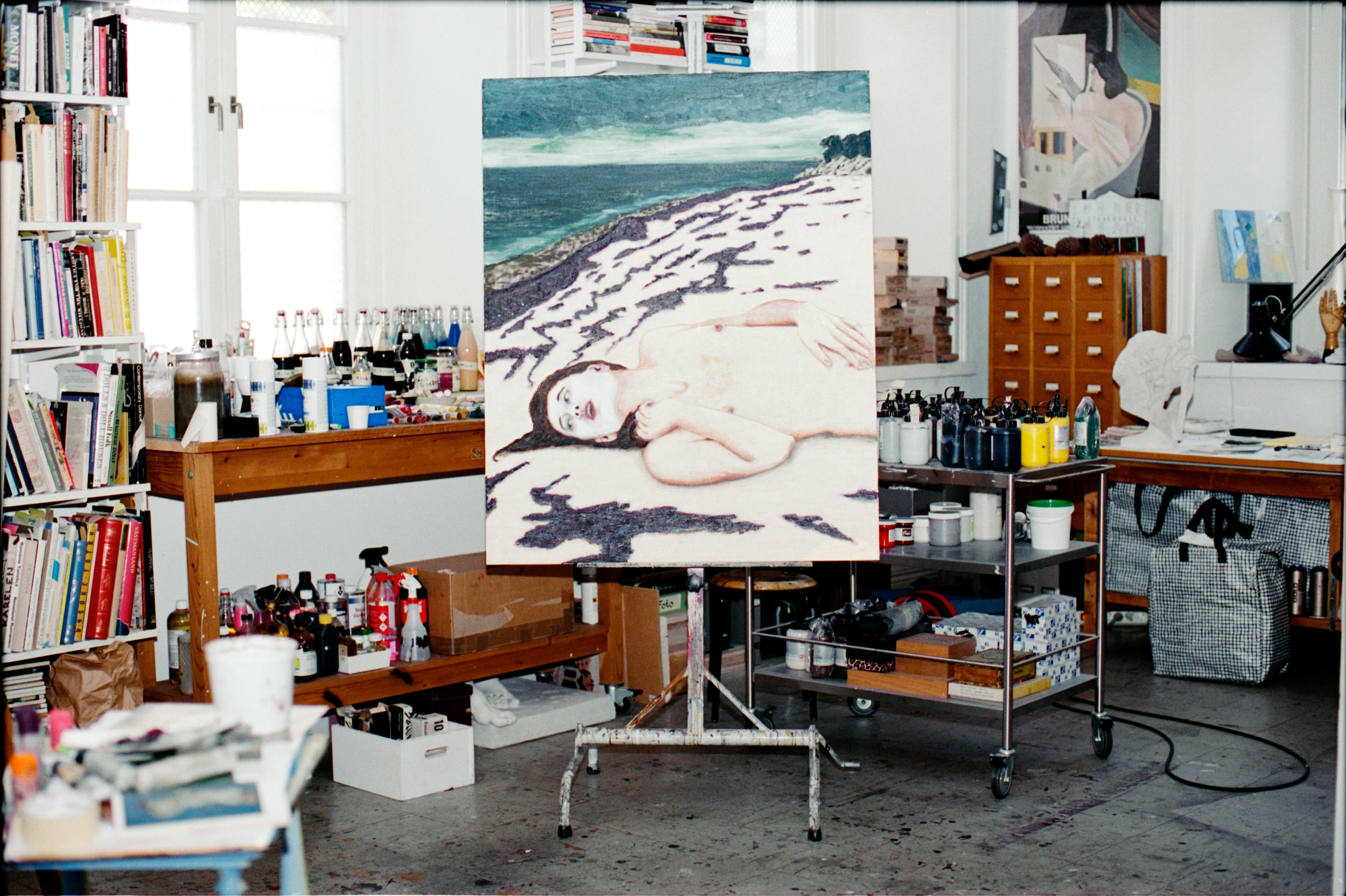
Mamma Andersson, The Lost Paradise I, 2020. Oil and acrylic on linen, 105.4 x 80.3 cm
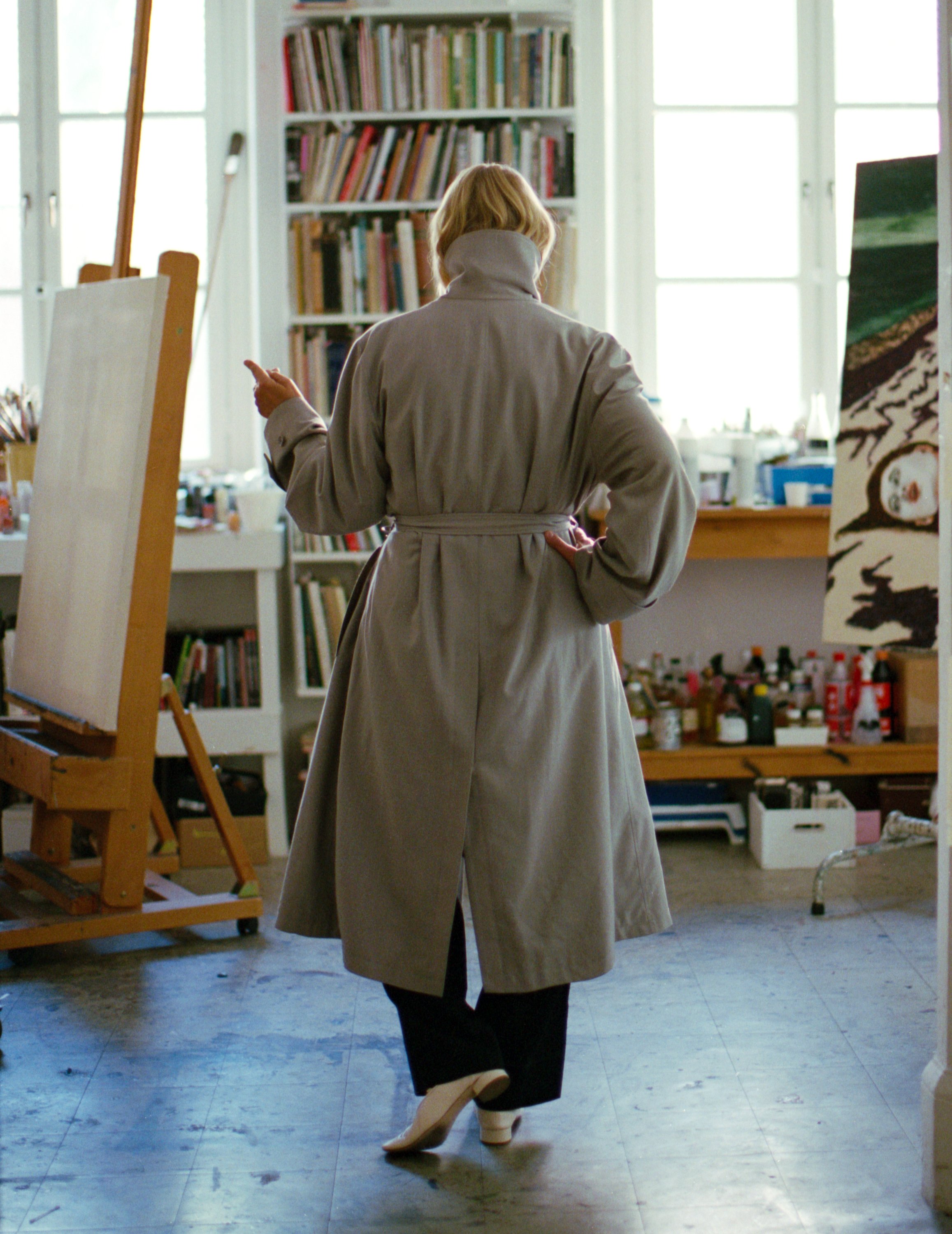
Mamma Andersson wears a coat and trousers by LEMAIRE, shirt, necklace and shoes artist’s own
Q: What kind of girl were you growing up in Luleå? What felt vital to you before painting entered your life?
A: I grew up in a small town near the Arctic Circle, in a safe, well-behaved family, with a sister seven years older. We had strong family ties. We spent much of the year outdoors or at our summer house by the sea.
When I was 20, I left for art school 500 km south. Looking back, I had a lot of energy—curious, social, engaged in many things, even some politics. I trained in athletics, skied, went to discos, loved dogs, went to concerts, acted, drew daily, and joined film clubs. Like many of my generation, I wasn’t distracted by phones or computers, they didn’t exist yet.
Q: How has being an artist shaped the way you relate to the world—its pace, its values, its expectations? Do you feel more distant from the world now, or more entangled in it?
A: I feel rather distanced from the world and reality, as if standing outside, observing what unfolds before my eyes. I no longer have the strong will to influence or engage with the truly catastrophic state the world is in. I even shield myself from the news; I used to listen constantly to the radio, but I can’t bear it anymore. Instead, I read books and watch films, go to exhibitions, visit museums. My family and friends are very important. To enter the studio and work, the noise of the world must be silenced—even if it is precisely that noise one sometimes wants to depict.
Q: You’ve spoken of colors that aren’t quite beautiful or ugly—sickly greens, shifting blacks. What draws you to those in-between tones, and how do you know when a color feels right?
A: Color is the painter’s instrument. Every artist’s palette looks different. It took me a few years before I had a palette that felt like my own voice, and it is still in constant change. To an untrained eye, the range of colors I use might appear the same year after year—but for me it is not. Colors are tied to my psyche, to where I am in life at a given moment.
There is also a purely aesthetic aspect, which is always subjective. What I find beautiful you might find ugly, and what someone else loves may jar with me. If I were to describe my palette today, I would say that every color has a place on it—all are beautiful in the right context.
Q: Can you recall a moment when someone said something about your work that stayed with you?
A: No, not any particular comment. But when I began at the Royal Academy of Fine Arts in Stockholm, several different teachers and professors visited my studio. What I noticed was that each one said something different about the paintings I was working on at the time. That was an important realization: suddenly I understood that no path was better than another, and that there is no universal truth. In the end, only you yourself know what you want to say, and in what way.
Q: Have you ever made a painting you later regretted?
A: Many times, most have never left the studio. A few have gone out into the world a bit too quickly, usually in pressured situations, when I was too close to have the critical eye and distance that is always needed.
Q: You once said each painting is a self-portrait. What did you mean?
In a sense, every painting is in some way a self-portrait, though of course not literally. Most of the water I draw comes from my own well, but sometimes I borrow from other sources.
Q: What’s your relationship to vulnerability in painting? Whose vulnerability matters more—yours or the viewer’s?
A: Vulnerability belongs to us all, but we cannot always bear to show it, sometimes it is necessary to hold it back in order to protect ourselves. When something truly moves us, it is probably because the composer of the music, the writer of the text, the director of the film, or the painter of the image has expressed something profoundly vital for themselves. Then the likelihood is great that someone else will also be touched and recognize their own vulnerability.
Q: You often obscure or avoid faces in your work. Why?
A: It is difficult to paint a face that we believe in, everyone knows what different expressions and gazes convey. Some artists make their living painting commissioned portraits, where the goal is to capture a specific person’s character. That is not how I work. One could say that I paint states of being or psychological moods, with hidden underlying narratives.
For a long time, I more or less avoided depicting people altogether; instead, dolls or sculptures became the actors in my paintings. But in fact, the painting that mattered most to me this past spring depicts a young man lying on a beach, his eyes wide open to the world. There are no rules in my work; I follow my impulses. Sometimes it becomes a human gaze, other times something else entirely.
Q: Do questions of truth or morality ever enter your thinking when you paint—in what you choose to depict, or leave out?
A: Not really. I don’t think about morality or truth in my work—at least not more than I do in life.
Q: Your paintings often seem to hover outside of time. How do you experience time—linear, cyclical, fragmented?
A: Time is really just a construction to help us understand where we are in life. But you cannot step outside your own time, everything we communicate is rooted in where we are right now, where we have been, and how we look ahead. I love going on historical walks—both in real life, like wandering through an ancient city, and in books, reading something written long ago. It gives you a taste of another time.
The years pass: autumn becomes spring, someone is born, someone dies, love comes and goes. Everything moves in cycles. But, as I said, in order to make sense of the world we live in—of history and of where we are now—we pretend that time is linear. It makes things easier to handle.
Q: How do dreams enter your work?
A: Dreams are a part of real life; in them we sort through experiences, worries, and questions. I find it difficult to catch hold of a dream upon waking, but I often carry with me a sense that something has taken place in the dream, a trace that stays with me through the day. When I paint at my best, my mind is open to the unconscious. I believe the unconscious is closely linked to the dreams of the night.
Q: You’ve said the world is ugly in a literal sense. What is beauty for you?
A: Yes, it is ugly in so many ways, but it is really the human imprint that is ugly, especially in modern times. Hopeless materials that cannot decompose, plastic, metals, electronic waste, and so on. Ravaged nature, huge ugly factories and logistics halls, commercial advertising taking over public spaces, bad design, bad architecture by people who cannot draw and rely only on their computers, buildings that so often lack any connection to their surroundings. Centuries-old craft traditions are gone, the love of making and the praise of slowness are no longer valued. Money rules: everything must be fast and cheap so we can buy even more mass-produced junk that ends up on our gigantic rubbish heaps and as plastic drifting in the world’s oceans. Respect for animals and nature was lost long ago.
And yet, our planet is truly magnificent —beautiful, dangerous, and exciting. We should have been more careful; then perhaps we would have felt better, and the world would likely have been more beautiful. What can we do about it now? I don’t know.
Q: Where do you see painting—or, more broadly, art—today?
A: Art is important, it always has been and always will be. It lives its own life and changes along with everything else; it mocks, entertains, comments, sparks debate, makes people feel and dream, and so much more. Art cannot be measured or contained, and that is precisely the point.
Words and interview by Murphy Guo. Photography by Angèle Châtenet. Styling by Matilda Sadeghi. Beauty by Jeanette Törnqvist @Lund Lund.