
Vincent van Duysen x Julianne Moore | Intuition First, Life Follows
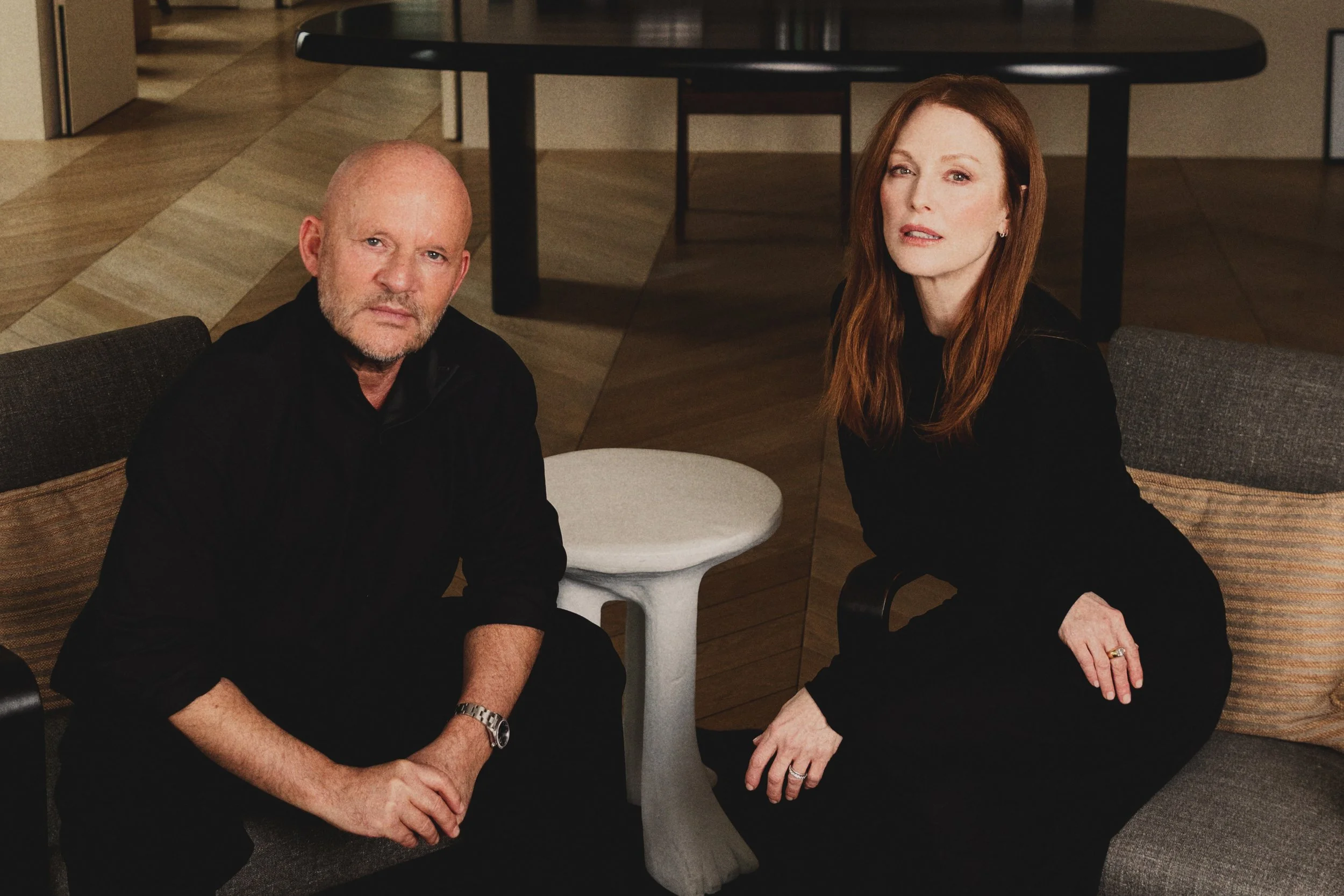
Vincent wears shirt and pants by Hermès. Julianne wears dress by The Row.
If there’s anything that can be built through stealing yet remain deeply genuine, it’s the friendship between Julianne Moore and Vincent Van Duysen. Long before they met in 2008 on the night of Julianne’s Blindness premiere, Vincent had unknowingly been a defining influence in her evolving journey through design. A self-taught curator of her own spaces, she instinctively tore pages from architecture magazines, gathering fragments of inspiration. Vincent’s work, with its quiet mastery of materiality and human-centric warmth, became an unspoken blueprint, helping her decode, in her own way, what a home should feel like.
It’s no secret that Julianne Moore, one of the most enduring and versatile actors of her generation, is known for her nuanced portrayals of complex characters. Yet beyond the screen, she is equally meticulous in her approach to design. Her five-story West Village townhouse, once widely admired for its harmonious dialogue between Greek Revival bones and contemporary restraint, revealed her intuitive understanding of space where objects, artworks, and materials interacted with a quiet, lived-in elegance. From the Akari lamp by Noguchi, which first introduced her to the world of design in her early 20s, to the organic, sculptural form of her Nakashima coffee table, to the recently completed renovation of her sprawling Montauk retreat, her philosophy remains consistent: design is instinctual, ever-evolving, and intimately personal.
Parallel to Julianne’s immersion in design, Vincent’s path as an architect and designer was also shaped by instinct. Raised in a world where art and craft were integral to daily life, he found in architecture a language to express and connect with the world through tactile form. Since founding Vincent Van Duysen Architects in 1989, his practice has grown into a multidisciplinary firm of over 40 collaborators, working across product design, hospitality, high-end residences, and large-scale architectural projects spanning Europe, the Middle East, Asia, and the USA. From the outset, his approach has been defined by a seamless relationship between architecture, interior, and product design—where spatial harmony and material essence take precedence. Since 2016, he has also served as the first non-Italian Creative Director of Molteni&C, bringing his refined yet deeply human vision to one of the world’s leading furniture houses. Yet, rather than being confined to a single discipline, he has expanded architecture into a philosophy, one that shapes how we live, what we surround ourselves with, and how space influences emotion.
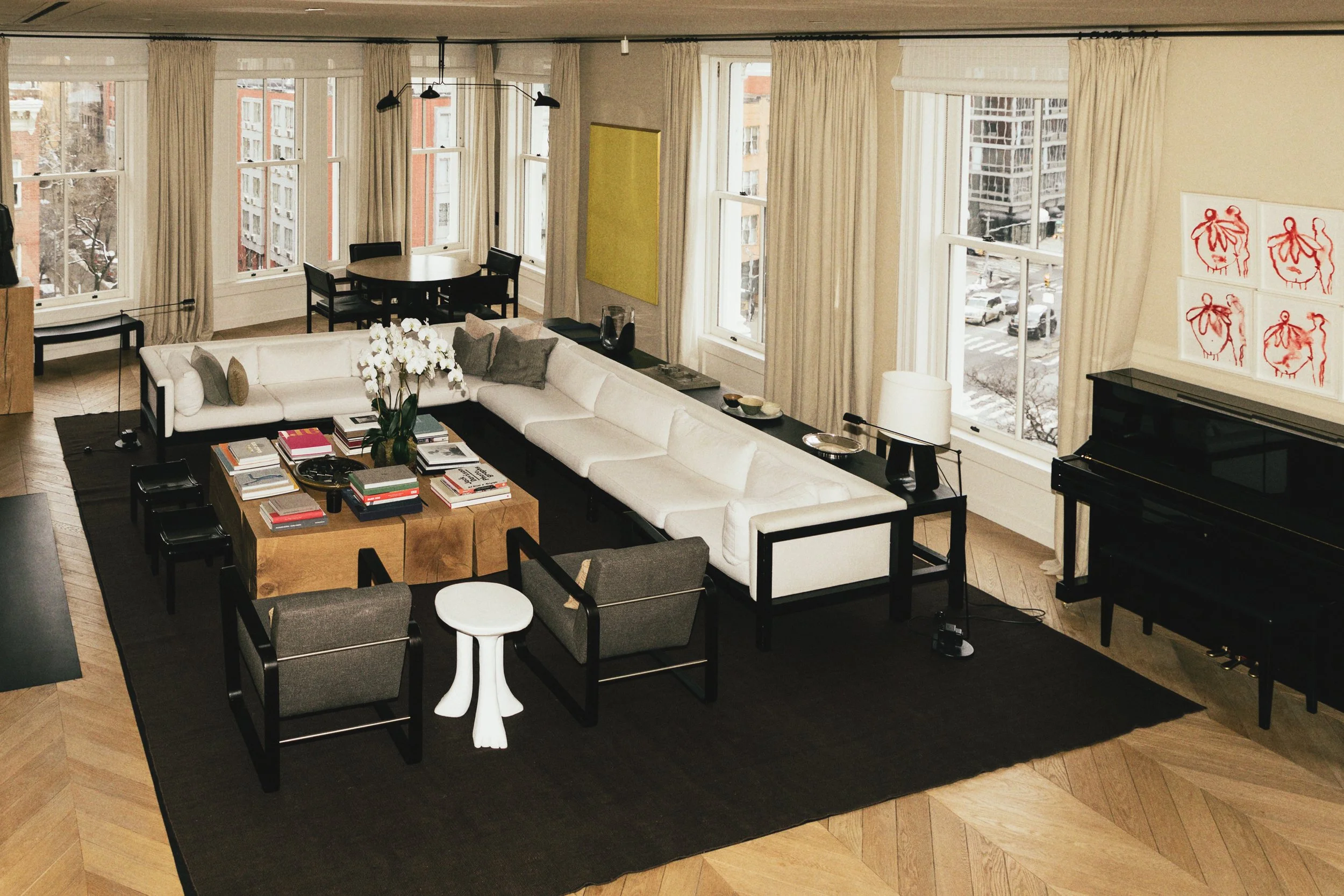
Their conversation unfolds in one of Vincent’s best-known projects, a landmark New York townhouse, where layers of French limestone, Carrara marble, French oak, and dark bronze exist in perfect calibration. In a city known for its relentless energy, the home offers a quiet counterpoint, embracing the family within its cast-iron frame. It is here, in this space, that the essence of their friendship becomes clear. Vincent enters with an unforced ease, shaking hands with a firm, steady grip, his presence light but assured. He jokes about not counting birthdays after 60, carrying a quiet exuberance that settles into every space he moves through. Julianne, ever attentive, listens with an openness that is both generous and intentional. She speaks with measured warmth, her responses precise yet unguarded, her presence—like her interiors—intimate without excess.
From their first meeting to their shared philosophies on materiality, intuition, and the soul of a home, their conversation is not just about design, but about life itself—about the spaces we build, the objects we choose, and the way they hold memory. In the exchange between two long-time friends, they reaffirm a simple but profound truth: good design is never about spectacle, but about creating a world that feels deeply, unquestionably human.
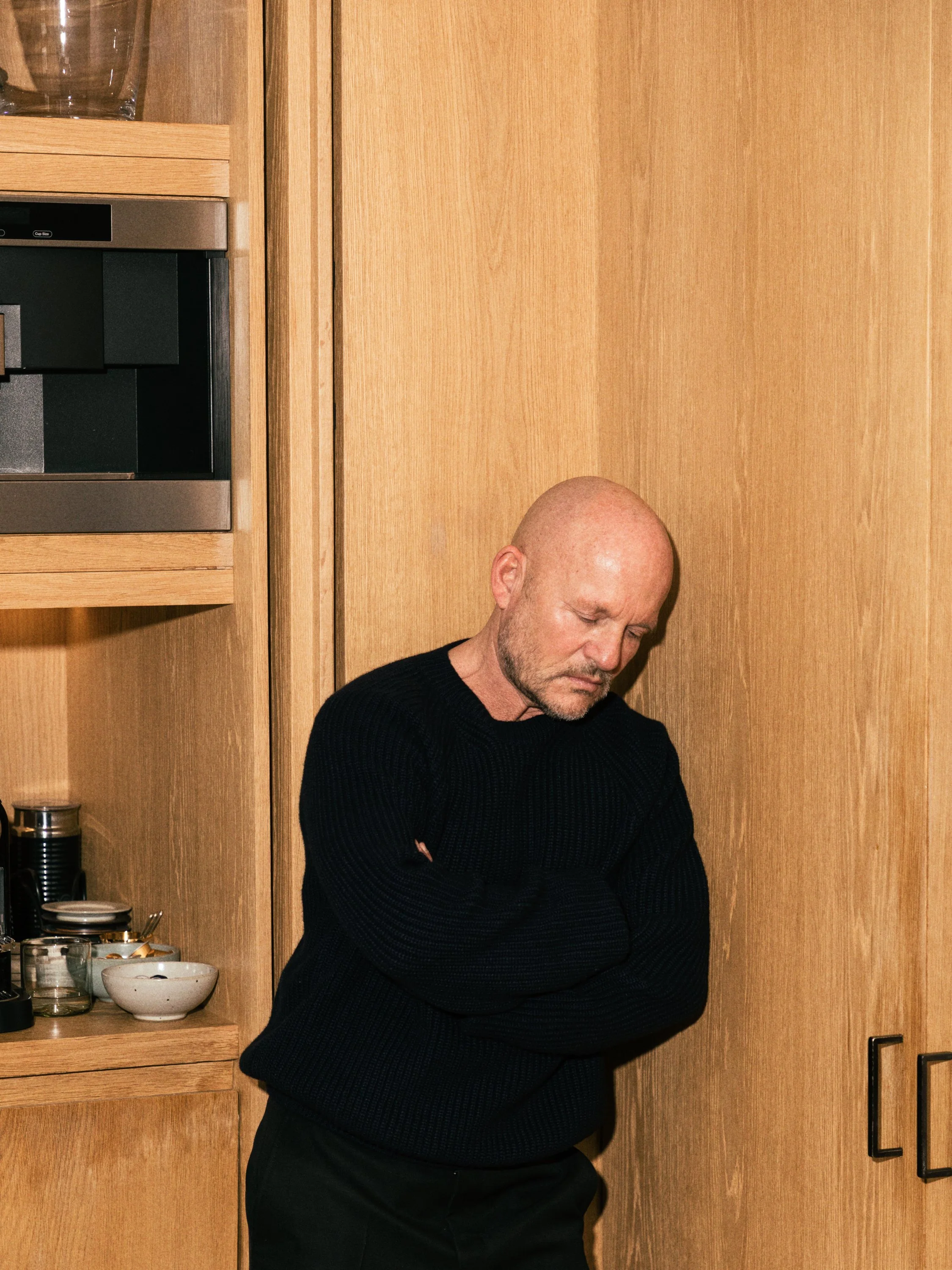
Vincent wears sweater and pants by Anest Collective.
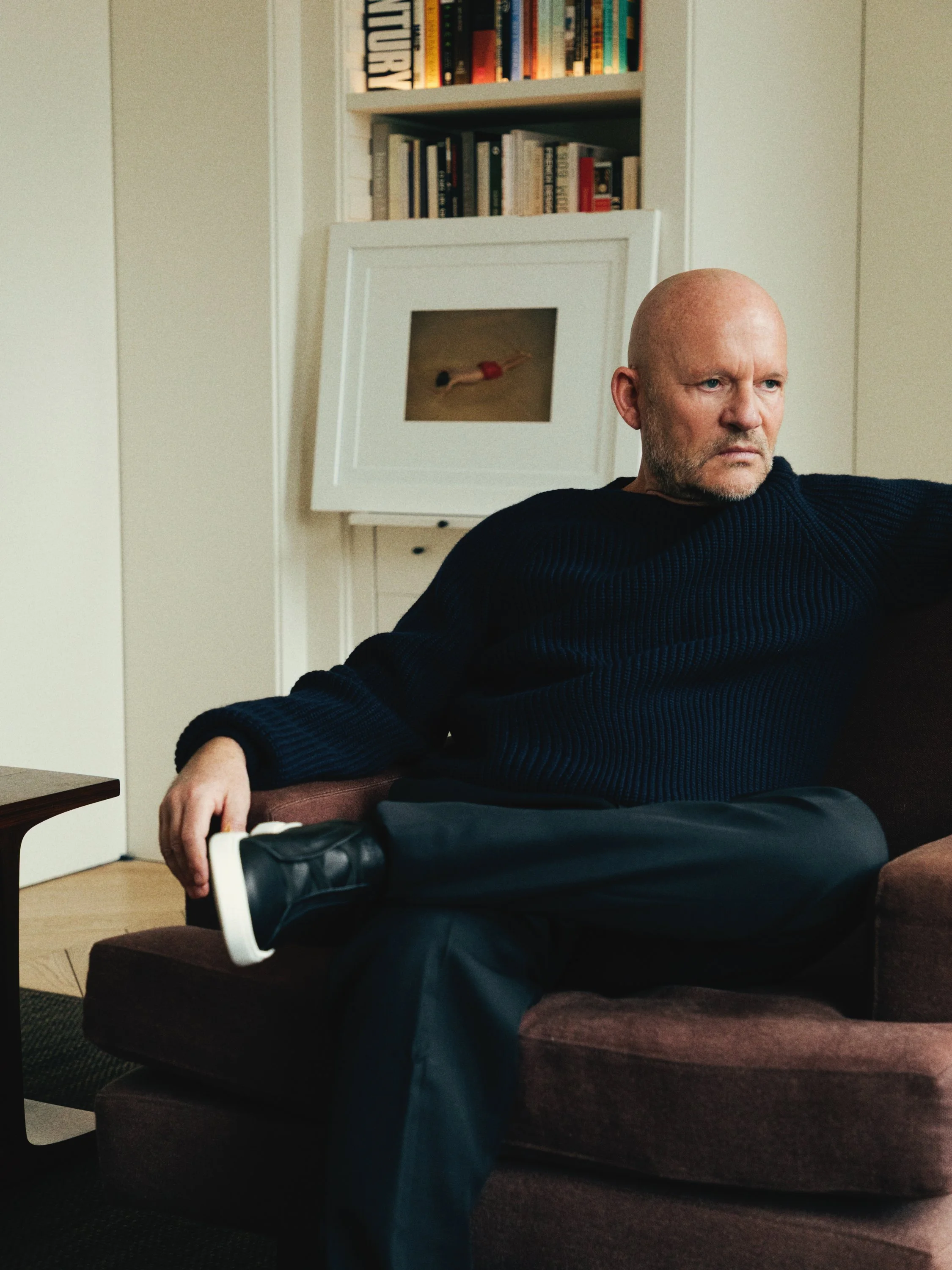
Vincent wears sweater and pants by Anest Collective, shoes by Zegna.
Vincent Van Duysen: I remember very, very well the first time we met. I was getting my first tattoo when Francisco Costa called me, it was so funny. He said, “You have to come and meet Julianne Moore. I’m invited to the premiere of Blindness at the Gramercy Park Hotel, and she keeps talking about you!”
Julianne Moore: All the time, whenever I could.
Vincent: He told me, “I want to introduce her to you.” And I was like, “Really?” I was literally sitting there getting inked. So I jumped off the stool, grabbed my jacket, and headed straight there. I remember arriving early, I was the first one there.
Julianne: Oh, you were?
Vincent: I was the first one waiting, and then you came in. Francisco was there—he came up to me and said, “Come in, let me introduce you to Julie.” You were already sitting with Bart, and he said, “Julie, I brought someone for you, Vincent, from Belgium.” And you just lit up and said, “Don’t tell me this is Vincent Van Duysen!”
Julianne: I couldn’t believe it.
Vincent: Bart looked at you like, “Julie, this must be an architect or interior architect. You’re supposed to be focused on the film!” But you were completely into architecture.
Julianne: I only wanted to talk to you.
Vincent: And that was it. You immediately asked for my email and phone number, and by the next day—
Julianne: —We were friends. You know, I was so struck by your work. It’s just so beautiful. The way you use materials, the textures, the precision—but also the warmth. I love modernism, but what you do has a soul to it. There’s an intimacy that makes it truly remarkable.
Vincent: Thank you, thank you.
Julianne: I’ve never seen anything like it before. I was so inspired by it and I continue to be inspired by it. Fantastic.
Vincent: But it’s true. Materiality and timelessness are two important elements that run through my entire career. I’ve always been drawn to natural materials. They come from nature—whether it’s beautiful woods, stones, or exquisite fabrics—because each has its own texture, its own character, its own beautiful imperfections, which is their true nature. And they all age beautifully, very naturally.
People often ask, “Why always natural materials? Why never synthetic or more technological, technical fabrics or materials?” To be honest, it would be a clash. From the very beginning, natural materials have been part of my process. I stay away from trends. I’m consistent. I have the eye of an architect. I’m a modernist in heart and soul. We love working with space, obviously, but what matters most is creating ambiences where people feel good.
Julianne: Exactly, feeling. That’s where materiality becomes essential, right? When you use a technical fabric or something artificial, you’re not necessarily considering how the space will feel, how a human being will experience it. But you always do. There’s an inherent sense of being alive and being human in your work.
Vincent: Not just alive, but profoundly sensorial. As you know, my work is rooted in materials, textures, and layers, but beyond that, it’s about engaging all the senses, what we see, what we feel, what we touch. That awareness is fundamental in everything I do.
Julianne: That’s so interesting.
Vincent: And I think it’s crucial. That’s where you sense the presence of humanity in the spaces I create. My work is always human-centric.
Julianne: Human-scaled.
Vincent: Exactly. It’s poetic, emotional. It invites curiosity—you want to explore, to touch, to discover. There’s warmth, but everything remains authentic and pure. It never feels excessive. My approach is about refinement—stripping away the unnecessary and allowing only what is essential, what is truly beautiful, to remain. Objects and furniture should be things you love, things that bring meaning to your everyday life.
Julianne: Right. And yet, there’s no formality to it. That’s the other thing.
Vincent: No, there are no rules. No rigid formality. What matters most is that the space is dedicated to the people who live in it. For me, they are the true protagonists of the architecture. And, of course, I have an ear that listens carefully to my clients—their personalities, their needs. It’s a beautiful and challenging process, infusing their essence into my vision as an architect. Because in the end, my goal is simple: for them to feel happy and at ease in the spaces I create.
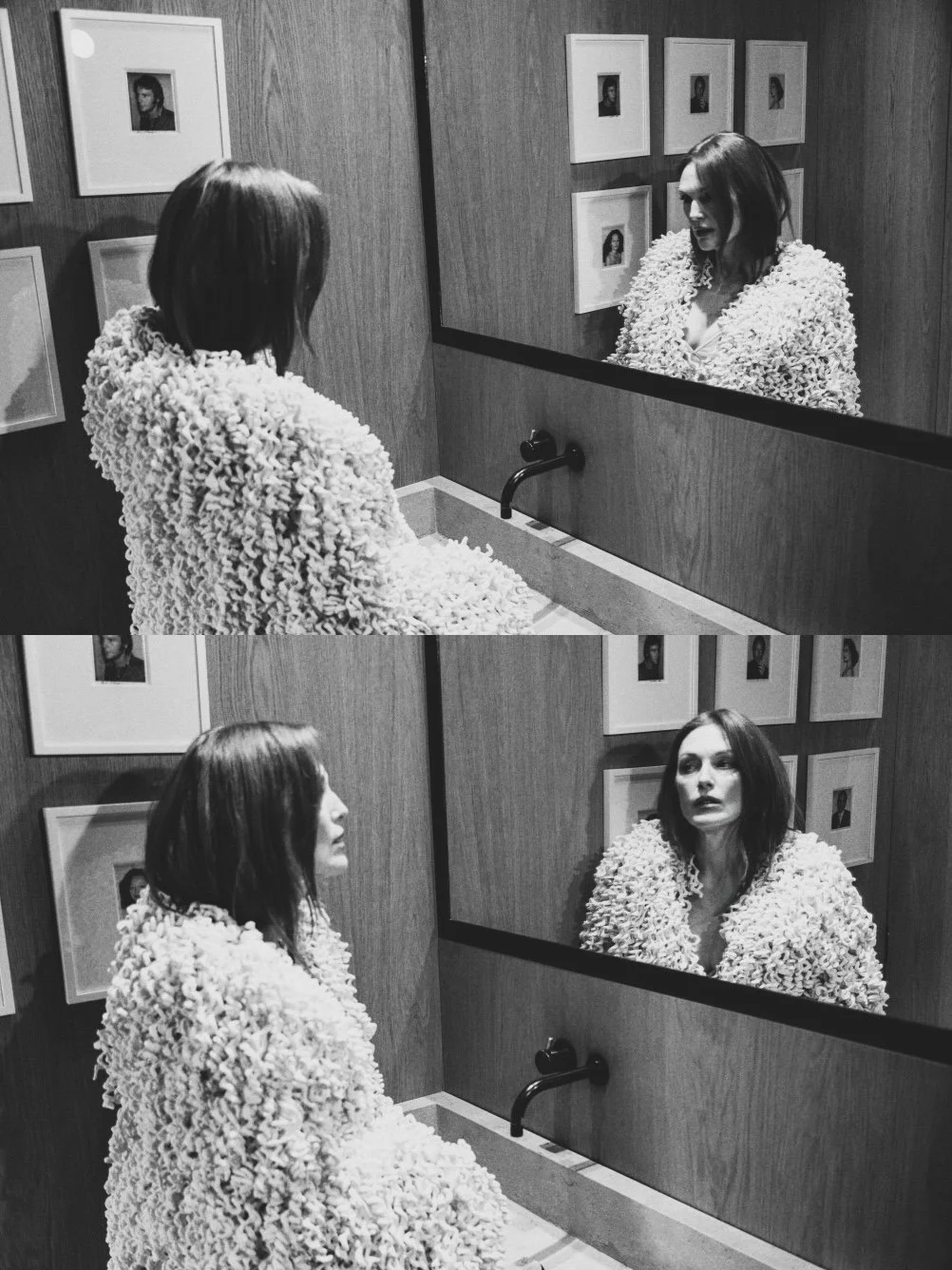
Julianne wears coat by Alaïa.
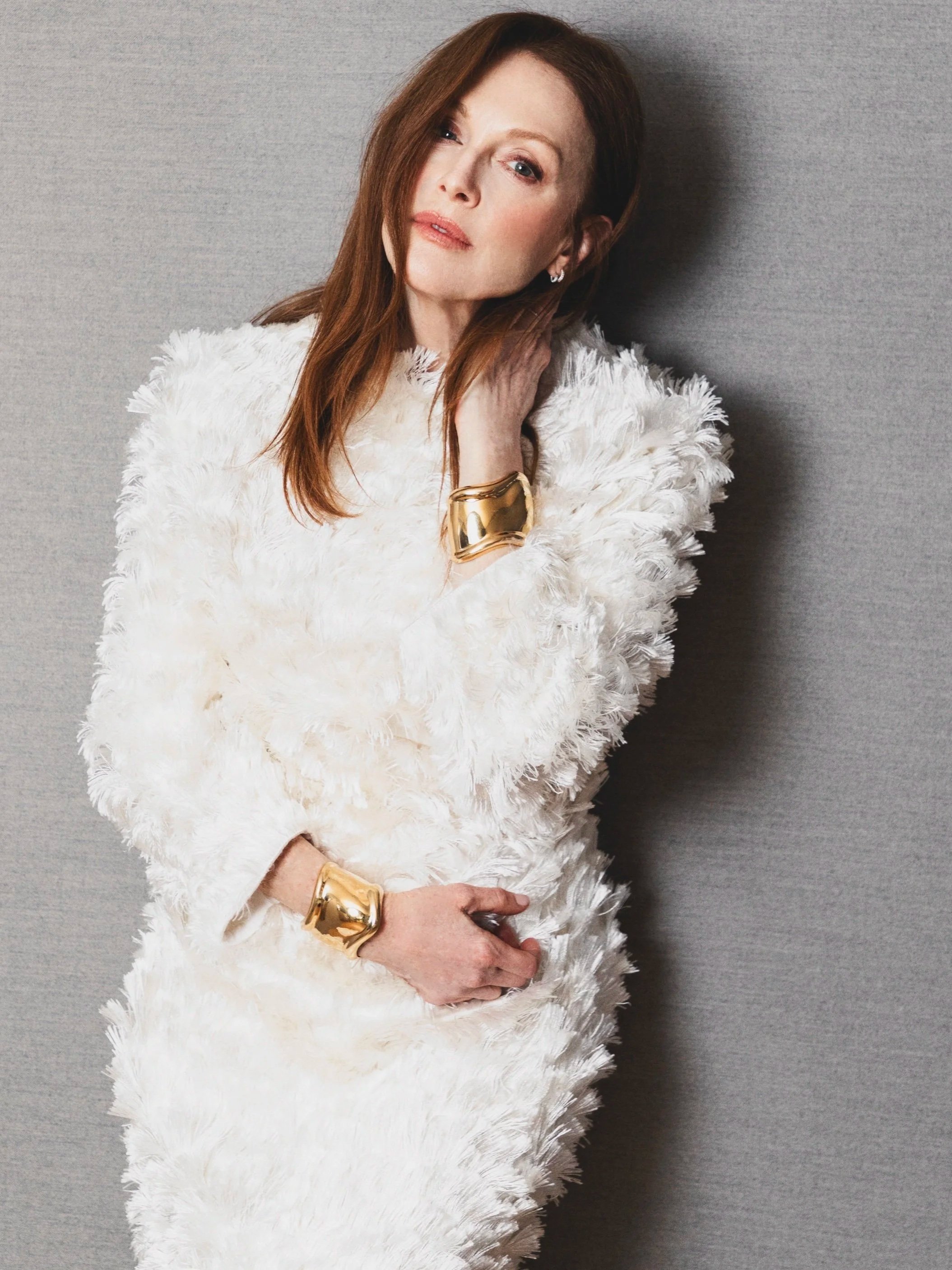
Julianne wears dress by Bottega Veneta, bracelets by Tiffany & Co..
Julianne: That was one of the things that impressed me most when we met, you had all these dogs, you loved kids, and you genuinely cared about families. You were interested in my family, in how I lived, in how others lived. That sensitivity is something so inherent to your work, your deep curiosity about people and the way they live their lives.
Vincent: It’s absolutely essential. If I had to name three things I couldn’t live without—things that are fundamental to my life—it would start with my late parents. You met my dad in Portugal, but not my mom. I lost my father just a month ago, and both of them were my greatest mentors. They shaped me, not just as a person but also in my career.
Second, my friends. I’m a deeply genuine person, and loyalty means everything to me. I’ve always been devoted to my old friends, the ones I truly connect with. It’s never about quantity, but about the few people you hold close, the ones you carry deep in your heart.
And then, of course, what you mentioned, my dogs. They are my unconditional love, my best friends. I could never, ever imagine life without them. Never.
Julianne: You know, it’s funny that you mention your parents because I was just thinking about how my mother was the person who really made me interested in design. She had such an artistic sensibility, not in a formal way, but in how she engaged with the world. She sewed, embroidered, knitted. She was always decorating our home, going to flea markets, refinishing furniture. But beyond that, she had an eye for beauty. She was always pointing things out to me—“Look at that. Look at that. Isn’t that beautiful?” She was training my eyes, without me even realizing it, to really see the world.
Vincent: I was thinking about that as well. She was shaping your eye, for sure. You’re a mother, an actress, a fantastic woman, a great friend, but beyond that, you have such a deep connection to design, furniture, and art. Where do you think that comes from?
Julianne: I think it was her. I really do. And it wasn’t until recently that I even realized I was a visual person. I always assumed that because I’m an actor, my connection to the world was primarily through words, through language. But then I started to notice that everything I remembered, I recalled in frames, almost like stills from a film.
I think that comes from how we moved around a lot, always entering new places and seeing them from a slight distance at first. And, of course, having a mother who took me to historical homes and museums. My father, too, they were both fascinated by architecture and design. It was always about noticing differences, asking, “Why is this beautiful? What makes this proportion interesting?”
And yet, I always feel like I wish I knew more. When it comes to design, I sometimes feel like I falter—I might not fully understand the mathematics or proportions. Which is why I lean on you. I’ll ask, “Vincent, take a look at this. Is this too big? Is this right?” Because to me, it’s all beautiful, but I trust your eye completely.
Vincent: We did it for Montauk, for the poolhouse, for Portugal. We looked at the poolhouse together—examining the little boxes, the proportions, the structure, the details—that’s what architects are for. But on the other hand, intuition is fundamental. It’s something innate, something you’re born with, like having an eye for beauty. Even intuition itself is a kind of vision. To be honest, you’re certainly not mathematical, and neither am I.
I may be an architect, but I’ve never seen myself as a purely mathematical one. I work instinctively. My approach is deeply intuitive, it’s my sixth sense, and I love that. Of course, I have an architect’s eye for proportion, but intuition is just as important, if not more. It guides everything I do.
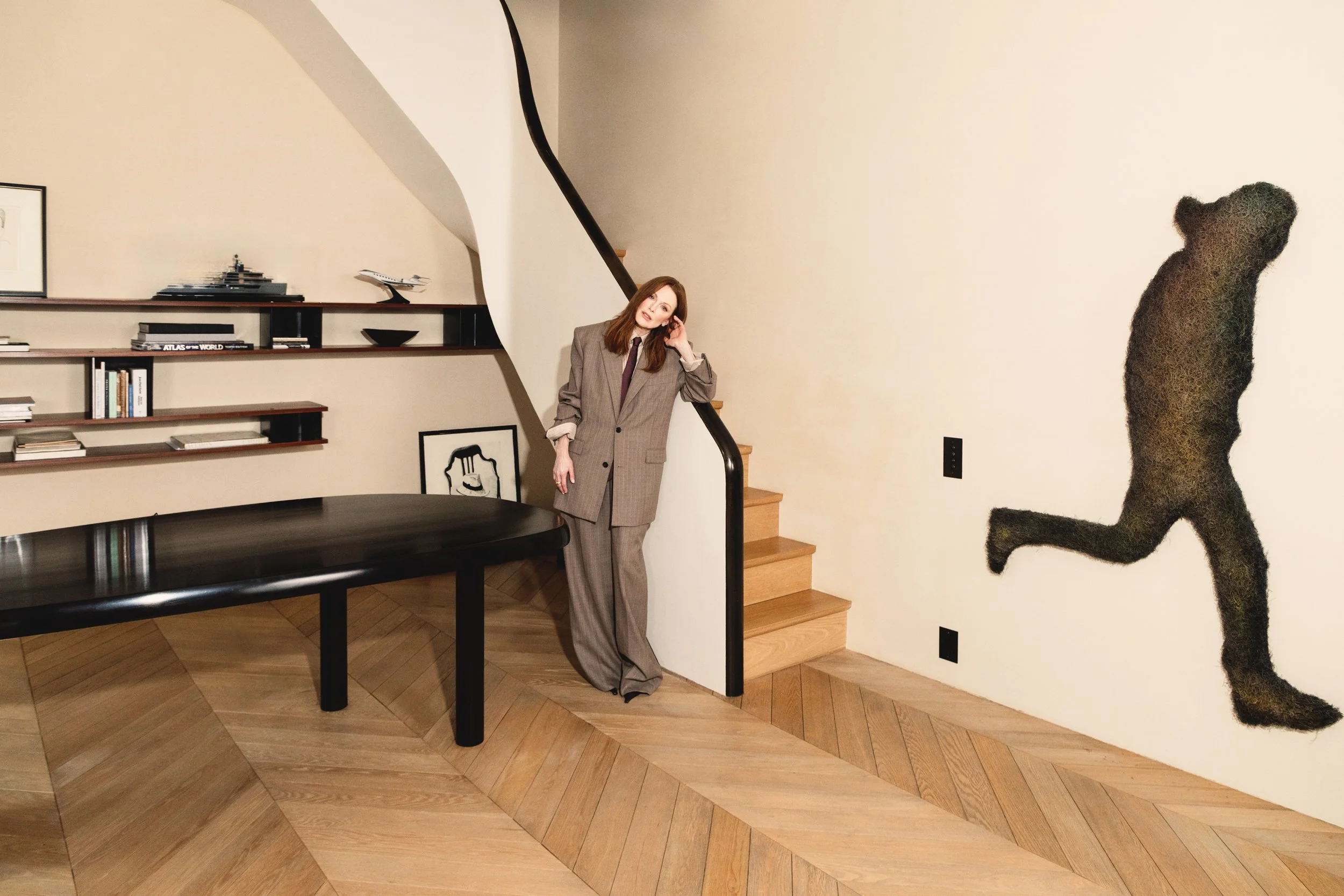
Julianne wears shirt, tie, jacket, pants and pumps by Saint Laurent by Anthony Vaccarello.
Julianne: How did it start for you, though? What led you to architecture?
Vincent: Well, I was an only child, raised in a very protective and conservative environment—boarding school, strict education. But I was always creative. As a kid, I was drawn to dance, theater, drawing, anything artistic.
My father, although he worked in the carpet industry, had a creative side. He loved photography, painting. It was part of our Flemish Belgian heritage. On my mother’s side, though, everyone was in law. Law, law, law. She was convinced I would follow that path, she thought my talkative nature made me a perfect candidate. But I kept saying, “No way. I want to do something in the arts. I want to listen to that instinct.”
Luckily, my parents had creative friends—painters, sculptors—and I was always fascinated by their world. Their studios, their way of living, everything about it left an impression on me. I knew then that I wanted to pursue something artistic.
One of their friends, a sculptor who also taught at the Faculty of Architecture, suggested that I study architecture. He told my parents, “Yes, it might feel too mathematical at first, but architecture is a multidisciplinary field. It will give him the freedom to do whatever he wants.” That idea stuck with me.
And in a way, that’s exactly what happened. I became an architect, but not in a conventional sense. My work extends far beyond architecture, it moves through interiors, product design, creative direction. I’d even love to do more with photography. And if I’m honest, I’ve always been drawn to fashion, to the idea of vestimentum (garment), clothing. The entire world of art has captivated me since I was a child.
Julianne: Well, that’s one of the things I really appreciate about your work, your ability to move across disciplines. I first discovered your interiors through magazines, tearing out pages of spaces I loved. Only later did I realize, of course, that you were an architect. And that’s something I truly envy the ability to create an entire home, an entire building, like your extraordinary house in Portugal. It’s so unique, so deeply personal, and completely in harmony with the landscape. It’s a special place. And also… impossible.
What made me laugh so much about your house in Portugal was the sand, right up to the windows. The rolling dunes. The way the landscape almost invades the house. And all I could think was, “Who is sweeping the floors all the time to keep the sand out of the living room?”
Vincent: Nature is essential for me. In all of my work, there’s a strong relationship between exterior and interior. The materials, the sensorial elements, they create a dialogue between the built environment and the natural world. And then, of course, there’s art. I collect art, I live with it. Because art is the expression of an individual emotion, it creates a connection between the artist and the viewer. But in Portugal, with the dunes, the sand, the vast openness, I don’t feel the need for any art at all. Nature is enough. It becomes the art. It brings serenity, a sense of calm. That dune literally rolls into my living room.
For the rest, I live with only a few, carefully chosen objects and furniture pieces. I approach interiors compositionally, in an architectural way. It’s about placement, proportion, restraint. Speaking of essentials—once, someone asked me to name three elements in my home that I couldn’t live without. And after thinking about it, I realized how much I’ve drawn from Jean-Michel Frank, the great decorator of the 1930s and ’40s in Paris. He worked almost exclusively with exquisite materials and minimal furnishings, nothing excessive, just what was necessary.
The first thing I couldn’t live without is a classic British country armchair, timeless, traditional, deeply comfortable. I have them in Antwerp, upholstered in black linen, and the same in Portugal. They’re my reading chairs, a place to settle in. The second is a large, solid wood table, oversized, but not just for dining. A table that functions as a work surface, a place for books, for objects, for life to happen around it. And the third, books. Books, books, piles of books everywhere. They are the ultimate source of inspiration. Whether architecture, design, photography, art, I couldn’t live in a house without books.
And I think we have much in common when it comes to home. I just visited your new place a few days ago, and I have to say you are unbeatable. Not only a brilliant actress but also an incredible interior decorator. You did it beautifully. And I think that’s why we connect so much, we share so many of these same instincts.
Julianne: Absolutely.
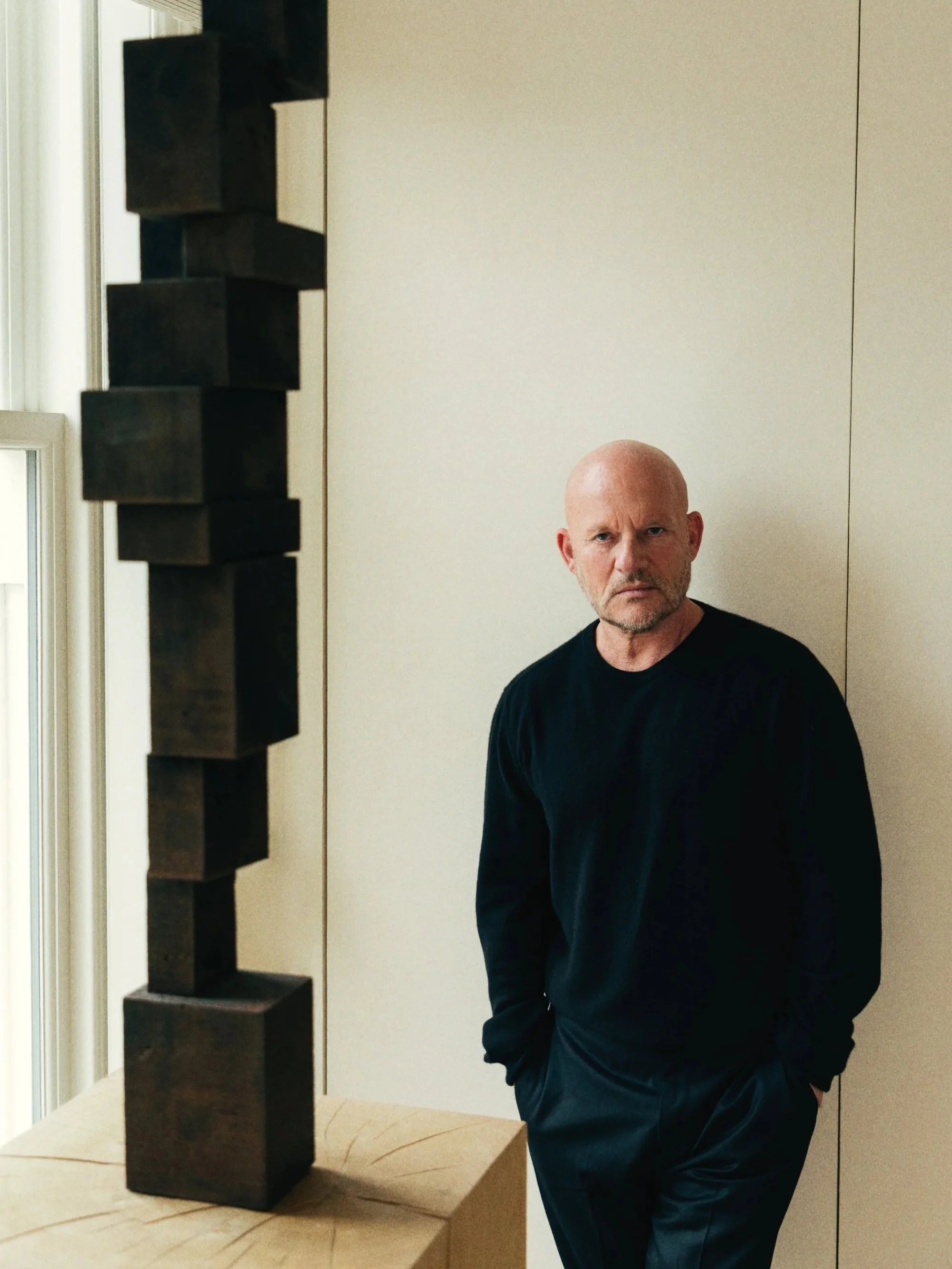
Vincent wears sweater by Hermès, pants by Anest Collective.
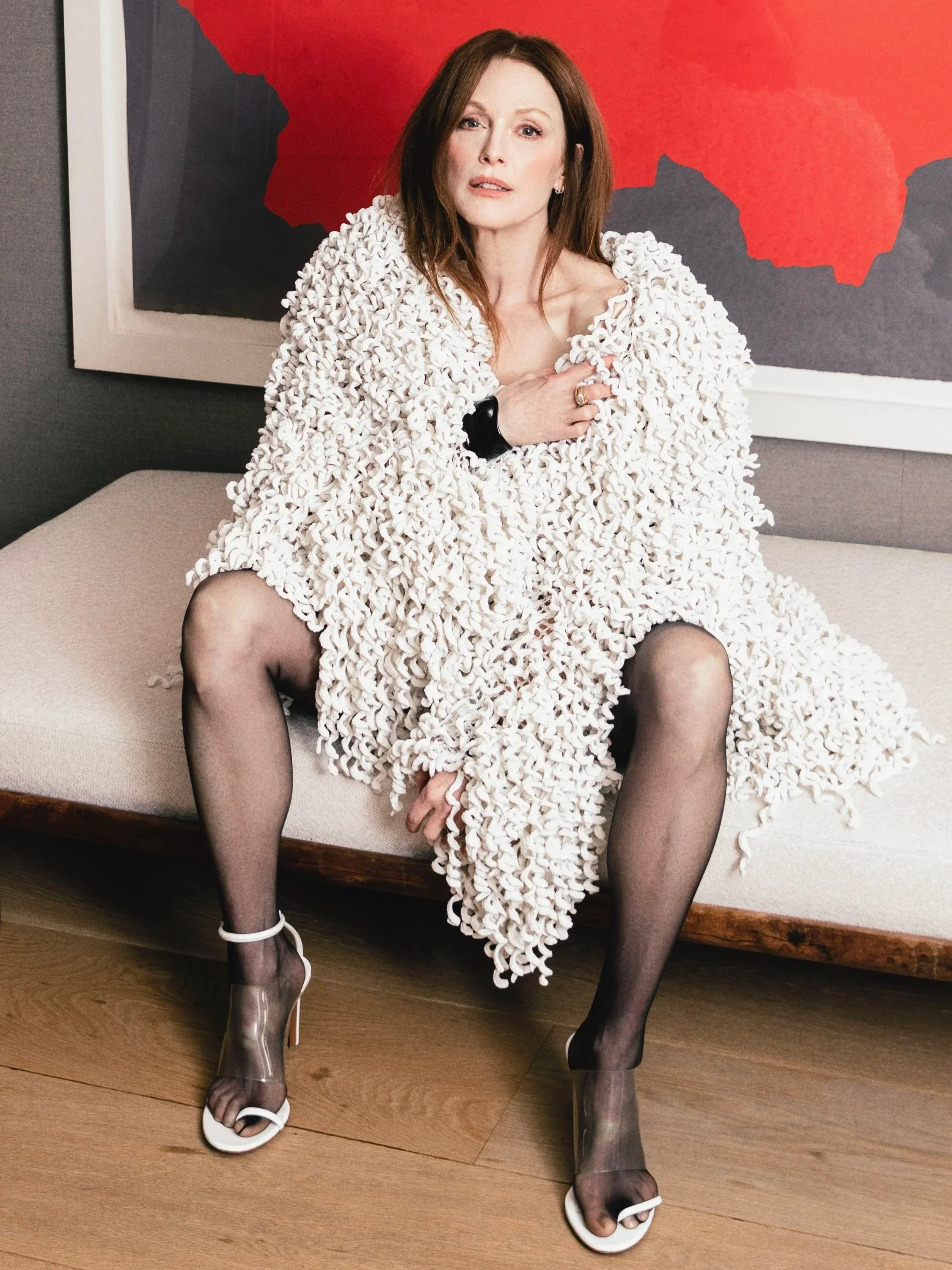
Julianne wears coat and sandals by Alaïa, bracelet by Tiffany & Co..
Vincent: Because, in a way, stepping into your home felt like stepping into my own. As I mentioned before, I could recognize so much of what resonates with me in your space as well.
Julianne: Well, I think we’re both really drawn to texture and shape. When I look around, I realize that when it comes to upholstered pieces, I prefer them to be almost brutalist in form—like the way a child would draw a couch. A very pure, basic shape. But at the same time, I love a beautiful fabric, something soft, tactile, something that invites comfort.
Vincent: Yes, the fabric in your home, it’s incredible. Absolutely amazing.
Julianne: But then, when I look at my other pieces—tables, chairs—I notice I’m always drawn to unusual shapes. That contrast, that interplay, is what defines the space. The more structured, almost brutalist pieces set off the more sculptural, organic ones. And for me, that mix isn’t something I plan all at once. It happens gradually. Everything exists in conversation with something else. You start with one piece, and then another follows, responding to it.
Vincent: Exactly. It evolves over time. It’s deeply personal, things you find, objects you source, pieces you fall in love with. That’s what makes a space truly yours. And these are elements you live with every day, so they need to feel right, to feel connected.
Julianne: I remember something you once said that really stuck with me. I told you I struggle with lighting, and you said, “Everybody does.” That made me so happy!
Vincent: Oh, lighting, let me tell you about lighting. My late father used to tell me, “You’re terrible at lighting.” And honestly, he wasn’t wrong. I’ve always struggled with it because, truthfully, I don’t like too much lighting.
Julianne: I don’t either. But you still need some.
Vincent: Exactly. You need just enough, side lighting, mostly. It’s about creating intimacy, an atmosphere. I don’t want a space flooded with spotlights, like I’m standing in a freezer.
Julianne: And you don’t need a million lamps either.
Vincent: That’s it. The rest just flows naturally.
Julianne: I was so relieved when you said that! I thought it was just me, but then hearing you say it, I loved that. Fantastic.
Okay, this might be a bit of a banal question, but what about color? I always feel challenged when it comes to color. What about you?
Vincent: A lot of people assume I avoid color entirely. It’s true that I have my own palette, but it’s not about rejecting color, it’s about working with the right nuances. For example, instead of a stark white box, I prefer something with depth, like bone tones. My home in Antwerp has textured plaster walls in a soft bone color, which almost gives them a material presence, you want to touch them, feel them. It blurs the line between surface and substance; you can’t immediately tell if it’s stone or paint. I love those subtle gradations—white to ivory to bone—because…
Julianne: Because, once again, it’s a color that appears in nature, right?
Vincent: Exactly. It’s a color that appears in nature, warm, neutral, and incredibly versatile. You can combine it effortlessly with so many elements. My palette, overall, is very much derived from nature, desaturated tones, nothing too bold or overwhelming. I tend to avoid harsh, saturated colors. Instead, the real touches of color in my spaces come from books, artwork, or carefully chosen objects—just subtle accents. But I could never live in a color book, you know what I mean?
Julianne: I do. But I also really appreciate how someone like India Mahdavi does it. She’s a true colorist.
Vincent: Absolutely. But also, cultural literacy plays a role. When color is embedded in your cultural DNA, it makes sense. I’m Belgian, from Flanders, and people often say my color choices reflect that heritage. And they’re right. Our palettes in Flanders tend to be desaturated, but there are subtle nuances within them.
And that aligns perfectly with my approach to timelessness. What I find most important in my work is creating serene, calm interiors. When color is too dominant, it becomes visually overwhelming, and, more than that, emotionally unsettling. It agitates me, activates me. And that’s just not who I am.
Julianne: That’s exactly how I feel about colored sheets. They’re too active.
Vincent: Exactly.
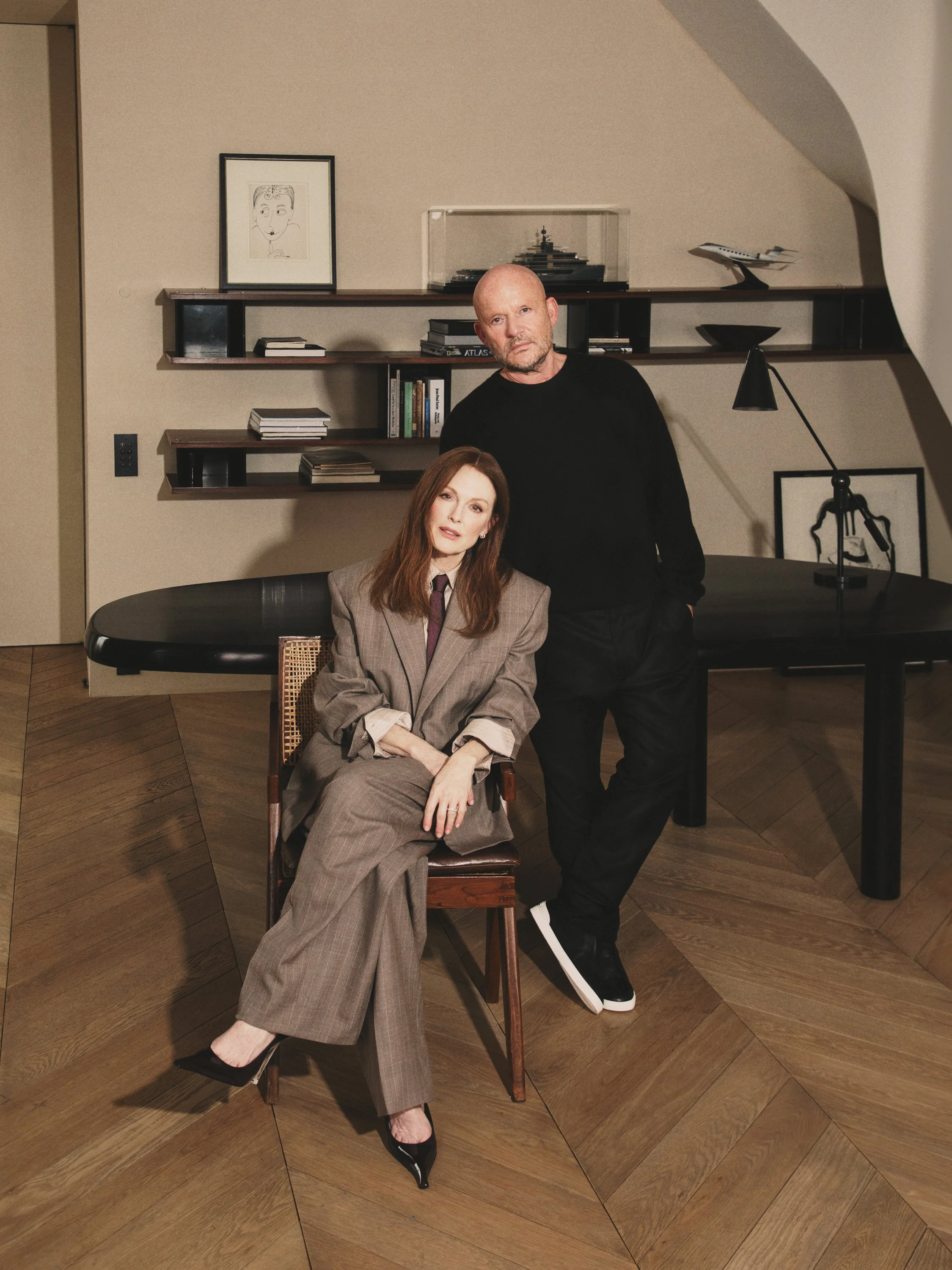
Julianne wears shirt, tie, jacket, pants and pumps by Saint Laurent by Anthony Vaccarello. Vincent wears sweater by Hermès, pants by Anest Collective, shoes by Zegna.
Julianne: When I think about integrity in design, I also think about authenticity. The real thing. What does it represent? What does it stand against? Integrity is about materiality—something that truly exists, something that isn’t artificial. And beyond that, it’s about function. It’s about making design work in a human sense, on a human scale.
Is the space being used as it should be? Are you sitting at a table where you can actually enjoy a meal? Are you watching a movie in a space designed for comfort? Can you reach the lamp from your bed? Those are the things that define integrity in design.
Vincent: I totally agree. And honestly, I’ve been grappling with the idea of integrity for many years. Not so much as an architect, but more so in design, especially now that I’m the creative director at Molteni and actively designing products. For years, I’ve been deeply involved in Il Salone, the annual design showcase in Milan, the so-called design circus, the pinnacle of the industry.
But lately, it’s all become… too much. It feels excessive. Things are moving too fast. People are losing sight of what design was meant to be, of where we once stood and where we should be heading. It’s an overwhelming quantity of objects, of ideas, all competing for attention. And in the end…
Julianne: And the expense.
Vincent: Yes, the expense. But beyond that, there’s a loss of authenticity, of purity, of meaning. That’s what scares me. I find myself wanting to return to something more grounded—back to the essence of design and architecture as it once was. It should be about dedication, about creating pieces that truly belong in someone’s environment, in someone’s life. These objects should stay in a home for a long time, not be disposable.
Julianne: I think the financial entry point is really important, too. That brings me to Noguchi. People often ask me how I first became interested in design, how I started working on my own homes. And for me, it started with discovering Akari before I even fully understood Noguchi’s work.
His Akari lamps were beautifully designed, essentially light sculptures. And as a 24-year-old putting together my first home, I could afford a small one. It was a big deal for me at the time, a major purchase. But it was something meaningful, something that added beauty and intention to my space, and that mattered.
Vincent: Exactly. It was accessible, yet pure, authentic, and poetic.
Julianne: Yeah. And it’s also about the legacy of a great artist. I discovered more of Noguchi’s work later, of course, and I deeply appreciate the breadth of his career, the incredible sculptures he created, the lifetime of extraordinary work. But what I love is that Akari still exists out there for people to discover and live with. It remains accessible.
That’s something I really struggle with, when design becomes too exclusive, when beauty is placed out of reach. Because beauty should be accessible, right?
Vincent: Absolutely. I completely agree. Unfortunately, we live in a digital world that has intensified this issue. There’s so much information, so much content, it’s overwhelming. We’re constantly absorbing, constantly being bombarded. And I think for younger generations, it must be incredibly difficult to navigate, to filter through it all, and to find what truly speaks to them.
That’s why, in my own work, I’ve made a conscious effort to stay true to my vision. I’ve remained continuous and consistent, both as an architect and as a person. At the end of the day, I just want to contribute to the world, to inspire, as much as the world continues to inspire me.
Julianne: Exactly, that’s the beauty in it.
Photographer & Creative Director Tang Siyu. Stylist Natasha Royt. Words Murphy Guo. Makeup Romy Soleimani. Hair Orlando Pita @home. Nail Pattie Yankee @Celestine. Production Jean Jarvis @area1202. Special Thanks to Rob Heyvaert, Kristien Cornette, Leena Clausell, Eugenio Cirmi, Slate PR.