
Nathanaëlle Herbelin | The More I Give, The More I Get
What place does painting hold in the world?
Painters were once the thinkers, the mirrors of their time, reflecting the world onto their canvases. Emotion, subject, and surroundings wove into a living story through mastery of color, texture, and stroke. But as time shifts, “the painter’s status as the official narrator of society has changed completely,” and art’s role grows uncertain. Painters are now expected to embed meaning beneath the canvas, yet audiences feel lost in deciphering messages rather than being arrested by a painting, stopped in their tracks by its presence. In the pursuit of concept, we risk losing not just craftsmanship—the sheer excellence of how it’s painted—but deterioratingly, the delicate meeting point where reality and imagination merge in a brushstroke—the fragile emotional connection that once made painting profoundly human.
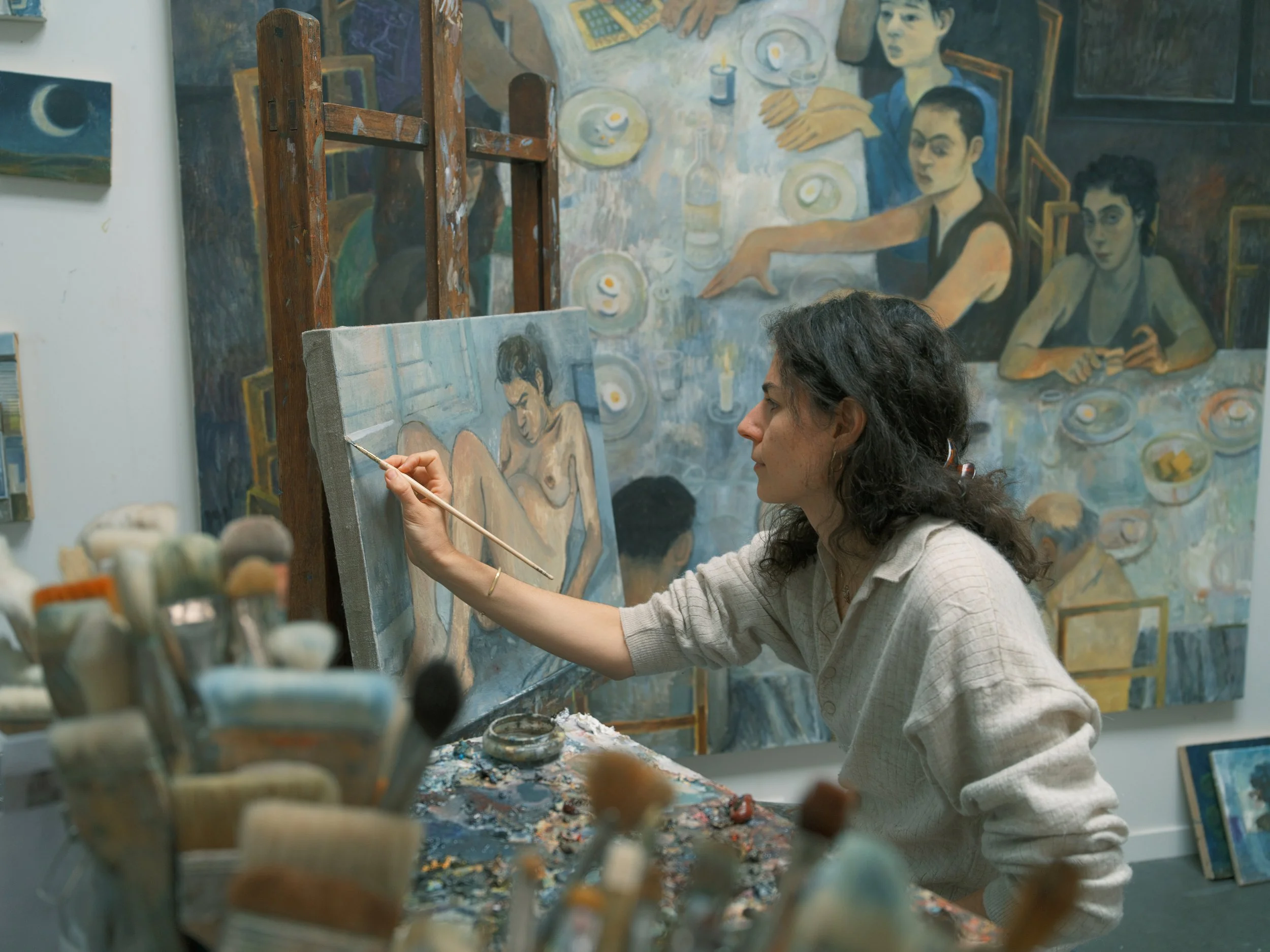
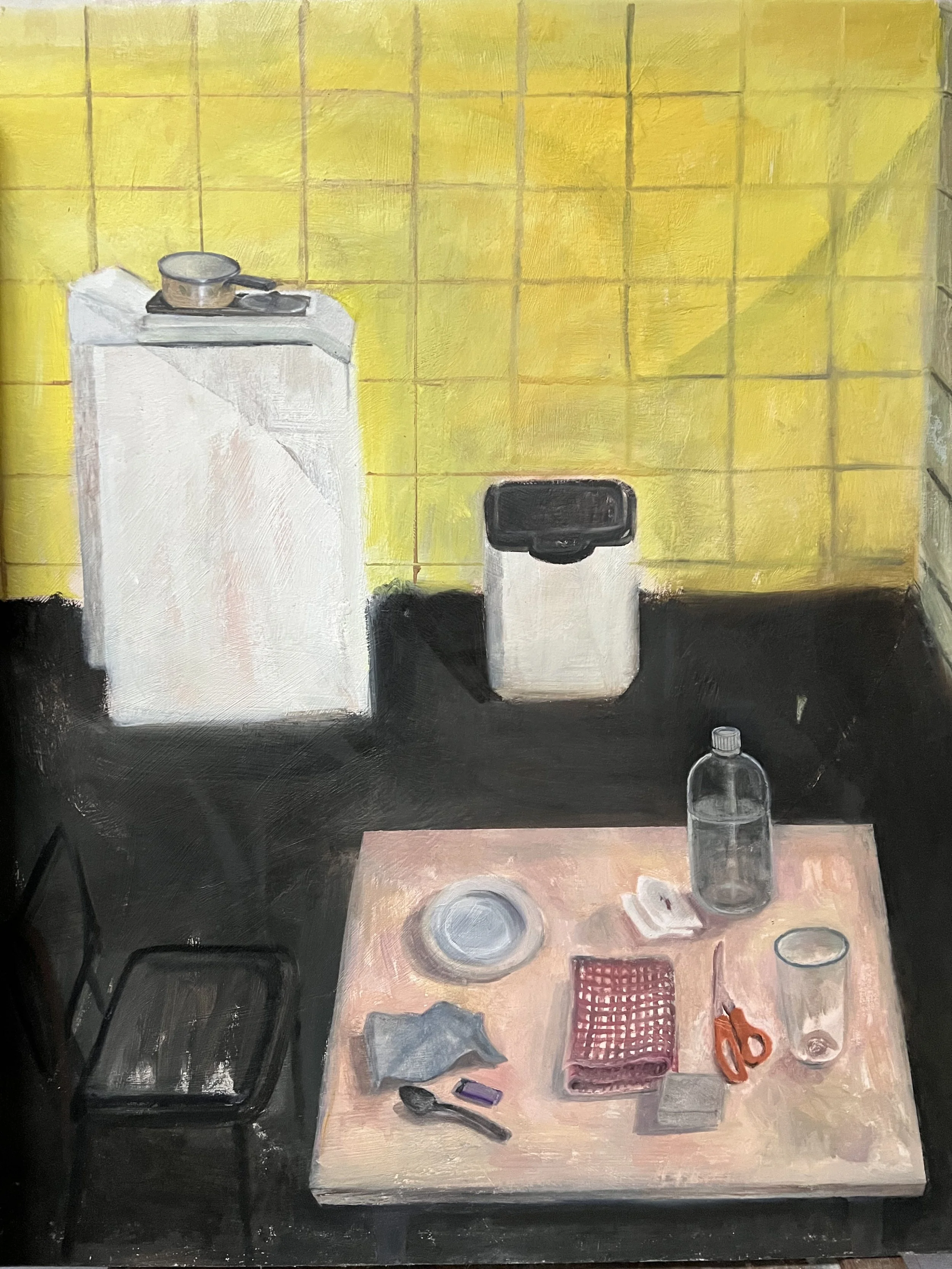
For a modern artist like Nathanaëlle Herbelin, nothing remains as true and open to possibility as painting. Deeply rooted in the exploration of daily life, domestic interiors, and intimate moments, her work captures the subtleties of human relationships and familiar spaces—friends, family, the quiet corners of everyday existence. While her work draws from the Nabis, her strokes carry the weight of belonging, grounding her in the world she paints.
She paints over old works when they offer new meanings, new dialogues. She paints when she travels, sharply attuned to the spirit of a place, translating its presence onto the canvas as if through the lens of her own eyes. She paints along the fine line between reality and imagination, shaping what feels most “urgent” to her. She paints portraits as a way of exploring the world through her models, where intimacy becomes a passage—an exchange of life, of presence.
Painting makes her “feel exposed,” but she doesn’t “feel the need to keep many secrets.” With age, she grows bolder, freer, unfiltered—much like her mother, her grandmother—women who lived with striking honesty, without pretense. Now married and a mother to a toddler who demands her full attention, she finds herself paradoxically more liberated, more devoted to painting than ever.
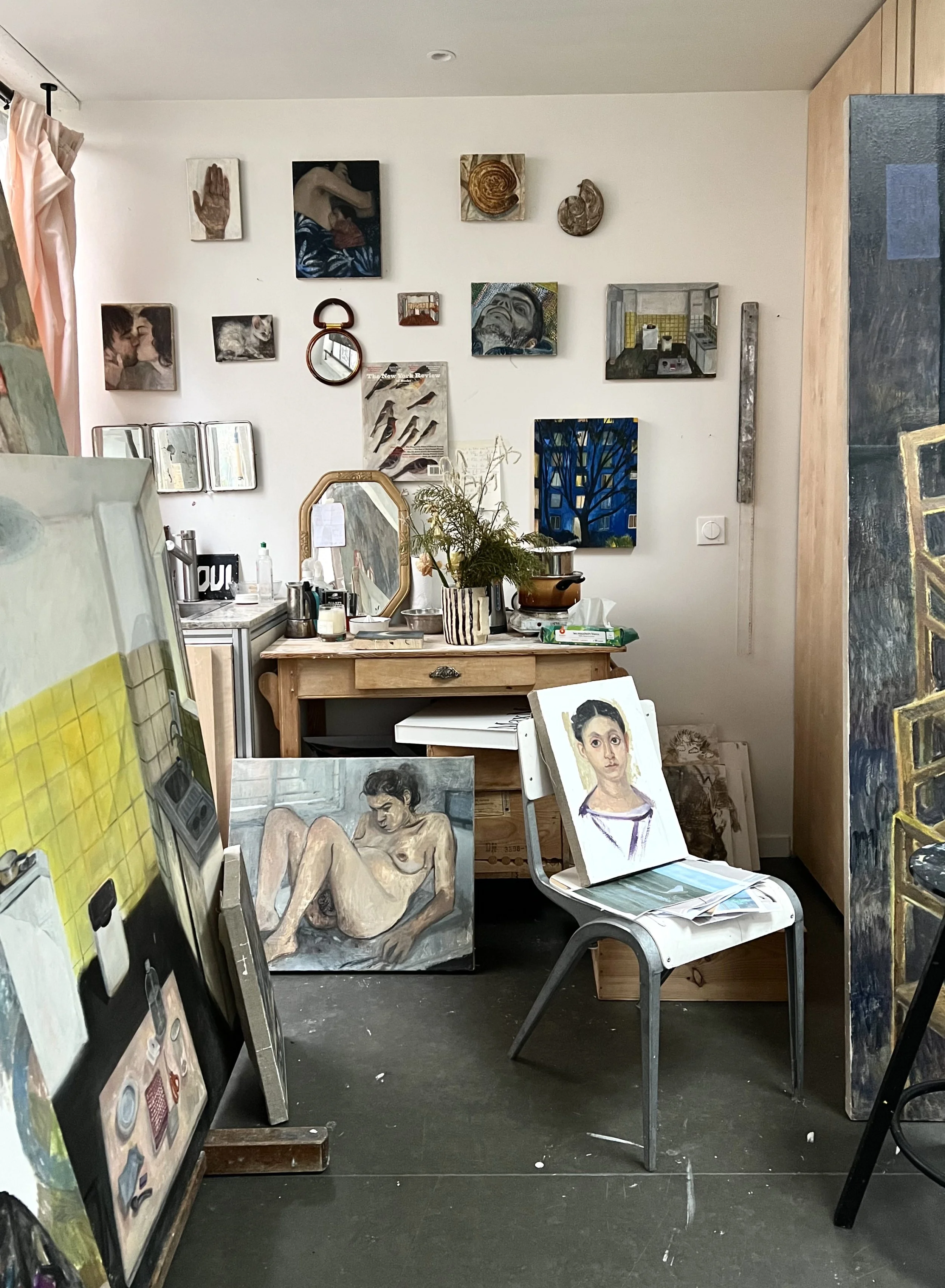
And here she is, in the lived-in side of Paris, in her studio: sitting before her canvas, holding her daughter, facing her own vulnerability. Painting the people she knows, capturing life as it unfolds, holding onto the faith in painting that she holds dear:
“The more I give, the more I get.”
Q: You often explore themes of daily life and domestic interiors in your paintings and also mentioned that when you decide what to paint, you “choose the most urgent thing”. What does “urgent” mean to you here?
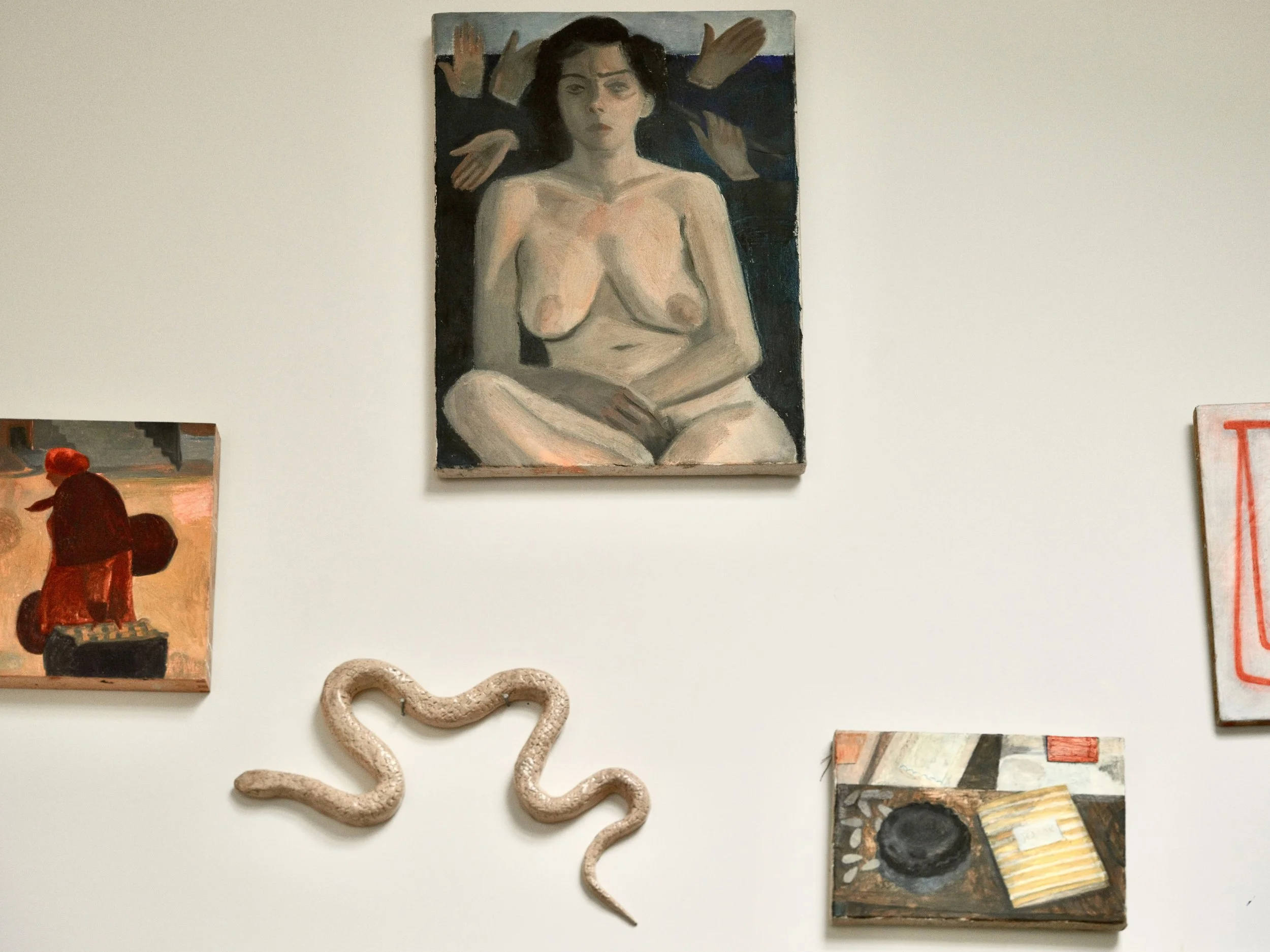
A: Painting has always been a way for me to process experiences. It may be a cliché, but it really has a therapeutic role in my life. By “urgent,” I mean something that is very loud in my head, painful, or simply preoccupying. Working in the studio is, at its core, a process of asking questions and investigating different realities—some very private and others broader, including sociological, political, and philosophical aspects. The most important questions I have at a given moment concern my motivation to paint and the subject matter. Painting can also be a dialogue with something I’m reading at the time, another creation, or an insight I want to depict. It’s a way of touching something that cannot be experienced in real life—for example, a father-son relationship or being a religious person. The closer it is to the time of the event, the more sincere it is, both for my personal process and for the painting itself. Once the scar heals, it becomes difficult to paint.
Q: How have your multicultural background and upbringing influenced your creative expression?
A: There has always been a sense of movement between my homes throughout my life, and as a result, my painting has also evolved between at least two places. The differences are striking: the objects, the light, and the body language of people—everything changes. It is very rich and stimulating. I also love traveling for work, and I don’t need anything specific in order to paint. In fact, routine doesn’t stimulate me. I prefer things that bother me—I want to be out of my comfort zone and challenged by my surroundings. This is exactly what helps me explore more variations in my work, allowing me to encounter interesting accidents or phenomena I could never have imagined on my own if I stayed in my studio all the time.
On a more fundamental level, it could be said that I grew up with an intuitive understanding of subjectivity precisely because my family was multicultural. Diversity and multiplicity are my starting points. From the stage of language acquisition in a bilingual home, everything has had two signifiers—two words that often carry slightly different meanings—undermining the dogmatic thinking that can arise in a more culturally homogeneous reality. It creates flexibility in perception and consciousness.
My curiosity about discovering different landscapes and ways of habitation is insatiable. I love arriving in a new city and experiencing that sense of newness and hope. It helps me stay focused. I then try to identify which element of the place best captures its spirit, reflecting what it really feels like to be there. Very often, I only fully understand the “mood” of places in retrospect. Because I mimic things fairly well, sometimes all I need to do is shut my brain off and simply “copy” the light of something or somewhere. I believe that if you can mimic well, you can be a good painter.
Q: You’ve shared before that you don’t want to repeat yourself, but you also don’t reject making one painting look like another. How do you see repetition in your work?
A: I just don’t want to create commercial “products,” so I do my best not to repeat paintings in terms of themes or gestures. Sometimes I’ll paint another version of a piece because I feel the need to prove I can do it better, using new painting skills or techniques I’ve developed. In other words, I’ll revisit an old painting and tell myself, “It’s a good subject, and it’s a pity it’s painted so poorly.” So, it might be worth giving it another shot.
It’s also very annoying if repetition occurs when I paint backgrounds for figures in the studio—sometimes I use the same studio setting as a background and it feels redundant. I don’t have a solution for this yet, but I’m very aware of it.
Q: It’s interesting that you often leave your paintings a bit “unfinished,” almost like they’re to be continued or have an open ending. How do you see the difference between finished and unfinished paintings?
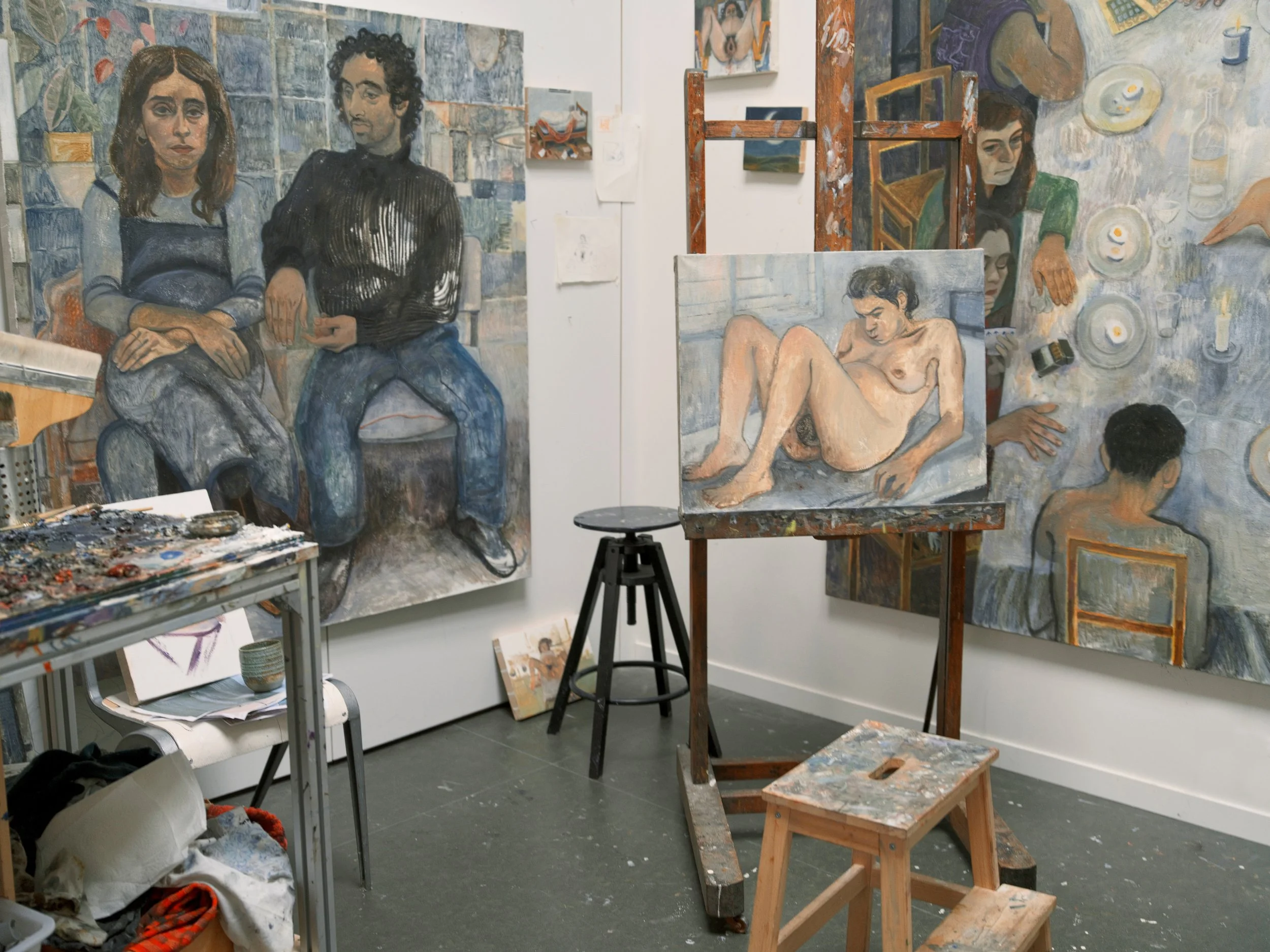
A: Most of the time, it’s because I painted models who came, sat, and then left. While they were present, I focused on them—not on the studio around them. When they left, the painting was done. I was reluctant to fabricate a new background or paint the studio behind them again. It seems to me that the most honest thing to do is to let them remain “naked,” free from any superfluous background.
And please, I don’t find them unfinished; I just think they have an unattainable dimension that I find interesting.
Q: Do you feel that keeping the scene as it is reflects something important about the role of painting?
A: I’m not sure. It’s the dynamic between the fictional and the documentary, the real and the fantastic, and all the layers of meaning that open up in between—these elements are necessary to tell a story in a captivating way. So, I allow myself a certain freedom and playfulness when navigating them. I find it very important not to rely solely on what I see; I’m constantly playing with the fine line between the “real” scene and my imagination. Also, what is real? What do I see compared to what you see?
You might already know I created that pregnant painting as an homage to Paula Modersohn-Becker—the first woman artist to paint herself nude in 1906. Not only did she paint herself nude, but also pregnant, although she wasn’t actually pregnant that year. That kind of tension between life, fantasy, prophecy, and the unattainable intrigues me profoundly.
Q: Painting on older, archival works seems to reflect your way of getting along with your past. What has evolved most significantly in your painting over time?
A: My grandmother, who passed away a few years ago, kept all my paintings that I once considered “unsuccessful.” I see them differently now—not only as experiences and experiments from the past, but also as reminders of the kinds of thoughts and compositional attempts I made. I now try to use them like phantoms, or pentimenti, in the background of my new paintings, echoing the past. When I feel they hold a certain added value, I allow them to reappear. They remind me of my younger self. As you can see in my work, I revisit the same themes again and again. There is an inherent risk in this, as revisiting the past means attempting to tell a different story about something frozen in time, unresolved. I have to return to it understanding that finding a way out may alter the original event, and I must accept that it might become something entirely different. So I enter with my eyes wide open, fully aware of the risk of losing everything there—or possibly saving it all.
Q: After getting married and having Elisha, what has changed in your life as an artist?
A: First of all, they are my best models. Painting them helps me understand us—each of us separately and how we evolve together over time. Beyond that, having a family fulfilled a need that was so loud in my head and body that even the studio couldn’t resolve it. Today, I work with much more emotional availability. Suddenly, I have the space to observe other people, instead of drowning in the whirlwind I felt before meeting Jeremie or having Elisha. Something new happened: weekends and evenings have reappeared in my life—times I no longer see as lost studio hours or wasted potential work time. The studio became physically separate from the house, and that gave me something new—a real home! It’s a clean space, far from the materials and mess of the studio. It feels pleasant and healthy. I worried this separation might make me paint less, but it’s been the opposite. I’ve never painted more, thanks to these times off, and I’m more focused on “deep work” in the studio. I just paint, without feeling scattered as I used to be.
Q: The concept of flatness in Les Nabis emphasized the canvas as a two-dimensional surface, offering both opportunities and limits. How do you see this approach influencing your work?
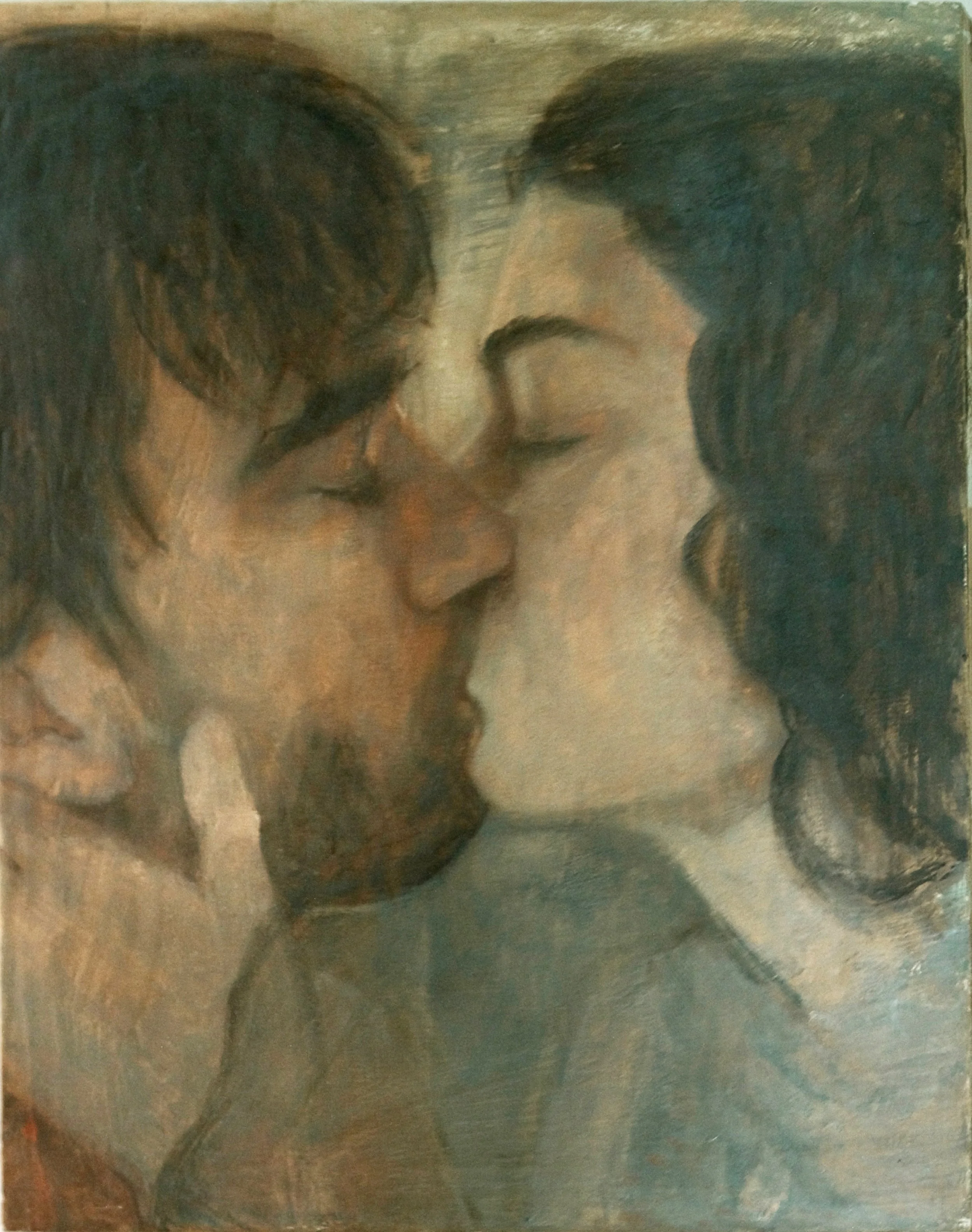
A: The idea of flatness definitely interests me. Take, for example, naïve art before the development of perspective, like in Giotto [di Bondone]’s works, or 19th-century naïve art such as that of Le Douanier Rousseau. Even semi-abstract artists like Etel Adnan, who engage with flatness, fascinate me. In my own work, I often play with dimensions; sometimes there’s a transition between two and three dimensions within the same piece. I’m intrigued and challenged by abstraction. Its relationship with geometry and symmetry deeply influences my practice, as some of my compositions begin with formal principles. When I work on “landscapes,” certain pieces nearly reach abstraction—particularly some of my interior paintings, especially in the backgrounds of portraits.
This brings me back to the question of real versus fictional scenes: dimensions can shift depending on the context. We see a very “real” figure, three-dimensional and full of sensual textures, yet behind them, there might be a two-dimensional background that’s not meant to be descriptive but to create its own universe. It’s as if the models are placed within a sort of “painting box.”
Q: The Nabis and Symbolist movements often focused on inner emotions and spiritual truths. How do ideas of spirituality or emotional depth play a role in your own creative process?
A: It seems to me that my spiritual and emotional work is essentially an act of synchronization. I seek to understand and deeply feel the phenomenon, place, or person I’m painting so I can merge with them for a moment. This requires great delicacy and deep attention. I want to discover their secrets and reveal mine through the act of painting. There is a sort of confession in this process, even if it’s somewhat encrypted. Some of these secrets may be sad, but others can be extremely exciting.
I’m deeply inspired by the concept of longing—an existential state, not just a fleeting emotion. Even when I’m with my family after dinner, I already miss them. With age, an “hourglass feeling” often grips me: a disturbing awareness that time will never return. So, the family dinner I’ve been longing for never feels entirely fulfilling because I know it will pass, and everything changes when I’m away. There’s also, in a more dramatic sense, the longing for those who’ve passed away. Painting my grandparents’ portraits played an almost religious role in coping with the pain of their absence and in celebrating their beauty. I really struggle to let go of the things I love, and that’s certainly one reason why I paint—painting is a way of holding on.
Q: What do you think is the reason that better painters are not from our times? If this is a retreat or step down from the past, how do you see the future of painting?
A: It’s true, and I’m sad to admit it: painters today simply don’t match the skill of the Old Masters. No one paints like Titian (Tiziano Vecellio) or [Francisco] Goya anymore. But I suppose that’s the case with many crafts these days—tables, houses, and so forth. We’ve moved away from the idea of “mastership,” focusing less on the technical and conceptual mastery of the medium, which I consider a real shame. On top of that, we don’t seem as concerned with texture. For much of our century, contemporary painters have used a similar texture for everything, whereas, in the 17th century, texture was crucial—think of the rise of still-life painting.
I guess we no longer try to master a field in the same way. In some ways, this is liberating, but the price might be that we no longer master anything. In previous centuries, as artists explored the possibilities of oil paint, each new movement pushed the medium forward as a whole. In every era, there were phenomenal masters who grasped something unique to their time and expressed it so fully that they gained canonical status. Of course, painting’s purpose has changed over time, and in recent decades there’s been some confusion (under the influence of postmodernism) about art’s role: What should we talk about? Which topics are actually important or interesting? So it often becomes a question of “message versus medium.” As painting itself and its narrative both come to the forefront, how it’s painted sometimes falls by the wayside. While it’s true that the painter’s status as the official narrator of society has changed completely, there are still vital political, social, and personal stories that can be told through painting today.
Q: You said you are “not a peaceful lady” and feel nervous, angry, or depressed at times. Does painting help you calm down? What makes you feel nervous, angry, or depressed?
A: Is that what I said? Wow, sometimes I reveal really private things. Painting does help me relax. If I have a good day in the studio, I’m nice to everyone afterward. If I have a tough day—where I can’t concentrate, make progress, or find inspiration—it weighs me down, and I become anxious. There’s a rule: there are no two good painting days in a row. If I have a really, really great day, I already know the next day won’t be as good, so I have to accept that and either go to the studio without expectations or skip it altogether if possible.
Q: It’s surprising to learn that you don’t deliberately choose your color palette because it speaks for you, but that it reflects you “just being shy.” What makes it hard to open up through painting?
A: No, I’m not shy about painting or anything related to it. I’m just shy when it comes to wearing or choosing colors—I’m shy about my clothes, for example. So sometimes that spills over into my studio life, influencing the colors I choose while painting. But I just turned 36 and spontaneously wore a shirt from my closet that I had never dared to wear before.
What I mean is that as I get older, I become bolder—not because I force myself, but because I gradually care less about how others see me. I think many people can relate to this: at around 40, something just opens up, and you feel much more liberated. I remember one day, I was sitting with my grandmother in a restaurant, and she said, “Look how handsome the chef is.” Before I even got a good look at him, she suddenly stood up, went to the kitchen window, and started talking to him. She had this specific way of chatting—she was basically hitting on him even though he was about 40 years younger than her. When she came back, full of pride and amusement, she said, “Tu vois ma chérie, mamie, elle a encore son charme.(You see, my darling, grandma still has her charm.)” Right then, I realized that when I get older, I’ll probably be the same way—no longer giving a damn.
It’s similar with my mother: I watch how she goes about her life, expressing herself without filters, with fascinating honesty. These women taught me how to communicate—through painting—the most difficult and interesting emotions and colors.
Q: How do you navigate between revealing your own emotions in a painting and leaving space for viewers to interpret it in their own way?
A: I believe the more honest and vulnerable I am, the more people can identify with the work in front of them. The more I give, the more I get, in a sense.
Q: People often feel connected, intimate, and perhaps echo the vulnerability in your work. How do you feel about this shared sensitivity with your audience?
A: The spectator’s connection to my work is my ultimate aspiration. I really just want to touch people through my paintings. In turn, they bring their personal experiences into the space created between us—between my work and their impression of it. It will never be the same for everyone, of course, but if a painting stirs something in them, reminds them of something real and important, or moves them, I find that wonderful.
On one hand, I’m completely open to that; I strive for this momentary union. On the other hand, it can be awkward because it’s very intimate, which makes me feel exposed. But I don’t have other solutions, since I don’t feel the need to keep many secrets. I’d rather be transparent because it helps me cope with life more easily.
For example, I think painting portraits satisfies my need to explore beyond my everyday reality, even though I live a very monogamous life. When I paint someone, it’s as if I’m—metaphorically—penetrating them with my eyes. Sitting with a model, this intimacy or connection is created so quickly, from zero to one hundred. I discover a lot about the person I’m painting; there’s a deep connection formed through transferring their essence onto the canvas. In the Bible, to know someone in Hebrew actually translates to having intercourse with someone. Having a viewer come and see these encounters is very private, but it’s okay, maybe I’m an exhibitionist.
Q: Your debut show at Xavier Hufkens was titled Undivided Attention. Living in a world full of distractions, what grasps your undivided attention?
A: Right now, my daughter Elisha. There’s something about parenting—about a toddler’s presence—that demands so much of your attention; otherwise, the moment is missed. There’s no pretense. So, I try my best to give undivided attention in that context, although it doesn’t always happen. But I’m already getting better at it.
It’s amazing, for the first time in my life, to be as dedicated and invested in something as I am in painting. It’s liberating in a way that the sacredness of painting is now shared with motherhood as well.
Q: You recently had a residency in China. What are some special stories or memorable moments from your time there? How did you find the experience overall?
A: It was really interesting to work there—such a different place from anything I know—and to see what emerged in my art. It was amazing to paint so many Chinese people and landmarks, from skyscrapers to landscapes, only to find out in the end that what they really hoped I would do for them was to paint Paris. It’s beautiful how “the other” can always be a kind of escape or dream destination, anywhere, for everyone.
I also tried to see as many exhibitions as possible and remember three paintings I really loved: a painting by Chen Danqing from his Tibetan series, featuring so many extraordinary faces; a factory scene by Xu Xingzhi (now I want to paint a factory, too); and a painting of funny eggs by Duan Jianyu.
Q: Who has influenced you the most in this evolution? What has been the biggest challenge you’ve faced, and how did you deal with it?
A: Oh, there are so many artists who inspire me. The first ones coming to my mind are different Fayum portraits, Alice Neel, [Hans] Holbein [The Younger], [Andrea] Mantegna, [Hans] Memling, [Paul] Gaugin, Pierre Bonard, Giotto [di Bondone]—just to name a few. I draw a lot from them. I look at their paintings because they make me want to paint.
Honestly, my biggest challenge right now is time—the lack of it—and how much of it goes toward everything but painting. If I could just stay in the studio for eight or nine hours a day and then go see exhibitions on the weekend, it would be a dream come true.
Q: What would you say is the milestone of your career so far?
A: I’d say the Musée d’Orsay show. I really didn’t see that coming, and it turned out to align wonderfully with the phase of painting I was going through at the time. A lot of what I’ve learned about painting throughout my life comes from my many visits to the Orsay—both in my childhood and later as a student.
Words and interview by Murphy Guo. Photography by Milena Villalón.